The Ted Dintersmith Portal
A tour of the math you'll actually use, inspired by Ted Dintersmith's Aftermath
Ted Dintersmith is a former venture capitalist who has spent years visiting schools around the country and arguing that American education needs to change. He produced the documentary Most Likely to Succeed, wrote What School Could Be, and lives just across the bridge from Newport in Jamestown. His newest book, Aftermath: The Life-Changing Math That Schools Won't Teach You (2026), takes on math class.
His argument, in short: much of school math is built around procedures, like factoring polynomials, memorizing trig identities, and computing derivatives by hand, that computers now do instantly and most adults never use. Meanwhile, the math that shapes our money, our health, and our civic life gets little class time.
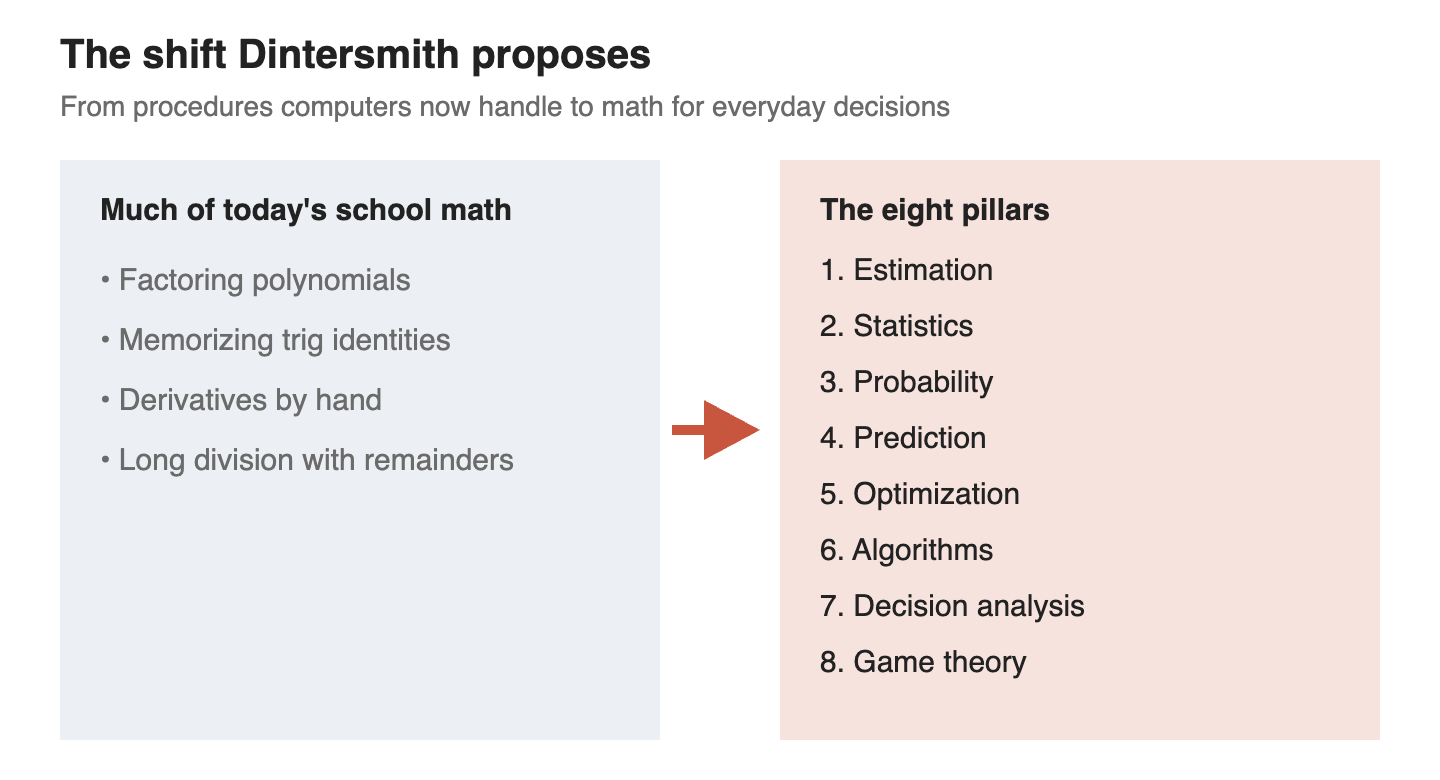
In its place he proposes eight "pillars" of useful math:
Estimation: getting a good-enough number fast, and knowing when a claim fails the smell test.
Statistics: summarizing data honestly and spotting numbers that mislead.
Probability: reasoning clearly about chance, risk, and odds.
Prediction: projecting trends, and knowing when a straight line lies.
Optimization: getting the most out of limited time, money, or materials.
Algorithms: the step-by-step procedures behind search engines, social feeds, and elections.
Decision analysis: making sound choices when you can't know how things will turn out.
Game theory: thinking strategically when your outcome depends on what others do.
About this series
The next eight posts take each pillar in turn: what it is, a worked example, where it shows up in everyday life, the most common traps, and a problem to try yourself, with the answer included. The framework is Dintersmith's; the explanations and practice problems are written for Math Thinking Coach. If an idea grabs you, the book goes much further, with stories of real classrooms doing this kind of math and challenges at the end of each chapter. It’s an incredible read!
You don't have to agree with every one of his prescriptions to see the value here. A student who can estimate, read a statistic critically, and weigh a risk is better equipped for nearly everything, including the voting booth.
A good warm-up:
When 99% Accurate Means About 9% Likely works through a probability puzzle that
Dintersmith also uses in the book.