Pillar 1: Estimation
Good-enough numbers, fast, and a smell test for bad ones
October 23, 2026
Part 1 of 8 in a series on the eight "pillars" of useful math in Ted Dintersmith's book Aftermath: The Life-Changing Math That Schools Won't Teach You (2026). The framework is his; the explanations and practice problems are written for Math Thinking Coach. Read the series introduction.
How many times will your heart beat in your lifetime? You can't look it up, and you don't need to. You can get close in under a minute.
Break it into pieces you can guess
A resting heart beats about 70 times a minute.
A day has 60 × 24 = 1,440 minutes, so that's about 100,000 beats a day.
A year has 365 days: roughly 37 million beats a year.
Over 80 years: about 3 billion beats.
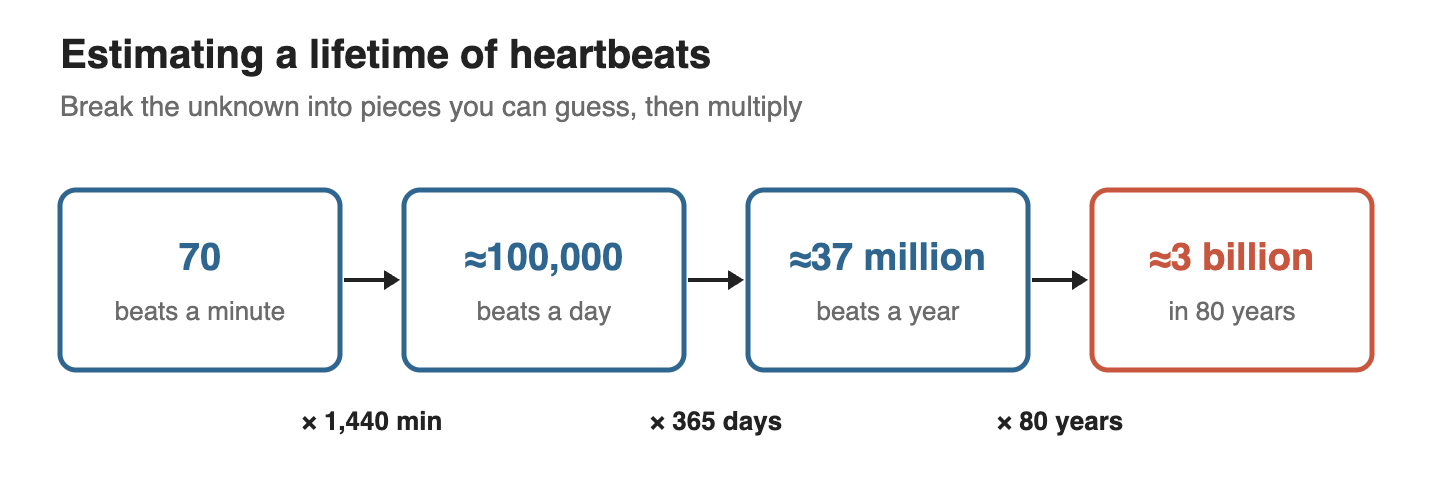
None of those inputs is exact. Your heart rate changes all day, and nobody knows how long they'll live. But the answer is almost certainly within a factor of two of the truth, and that's what matters. You now know the number is in the billions, not the millions or the trillions.
This is called a Fermi estimate, after the physicist Enrico Fermi, who was famous for answering questions like this on the back of an envelope. The method is always the same: break a number you don't know into smaller numbers you can reasonably guess, then multiply.
Round freely along the way. If 70 × 1,440 feels hard, call it 70 × 1,500 = 105,000. Rounding errors are small next to the uncertainty in your inputs, and they tend to partly cancel out.
The smell test
Estimation's most useful job is catching numbers that can't be right. Suppose you read that a city of 25,000 people produces 50 million pounds of trash a day. Divide:
50,000,000 ÷ 25,000 = 2,000 pounds per person, per day.
That's a ton of trash per resident, every day. Something is wrong. Most likely the figure was per year, which works out to about 5.5 pounds per person per day, in the range Americans typically produce.
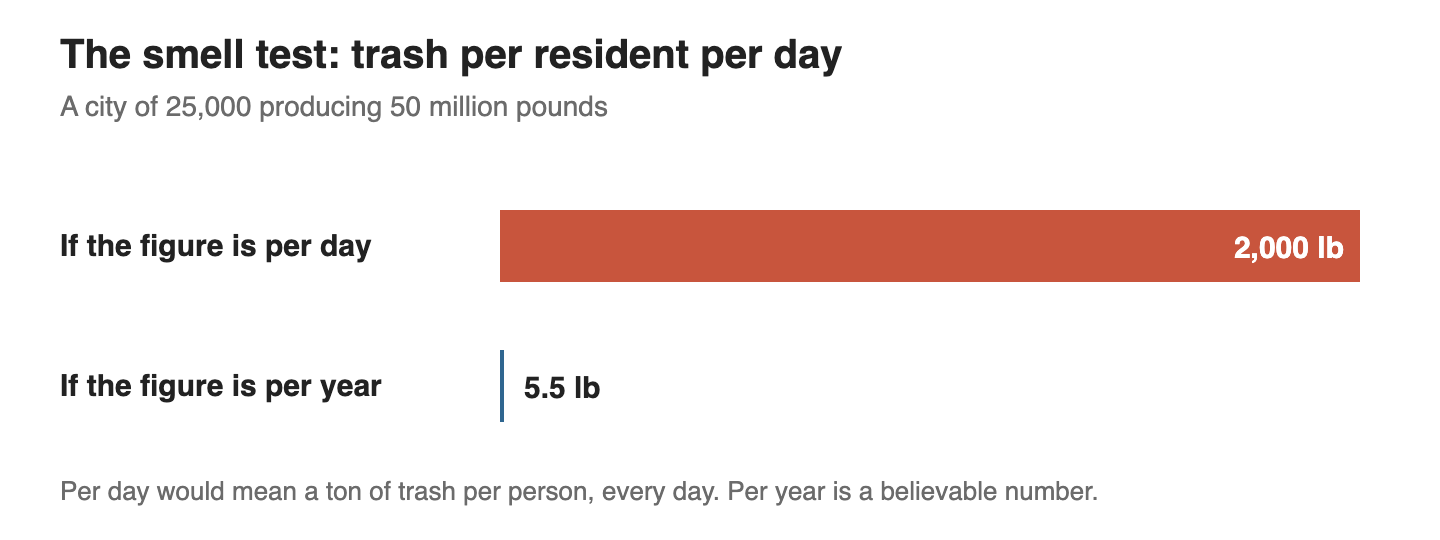
Dintersmith argues this habit is worth teaching: before you believe or repeat a headline number, check it against a quick estimate and see whether it passes the smell test. Dividing a big total by the number of people is often all it takes.
Know how sure you are
A second skill is knowing how uncertain your estimate is. Try this. For each question below, write down a range you are 80% sure contains the true answer:
How many bones are in an adult human body?
In what year was the Eiffel Tower completed?
What is the average distance from the Earth to the Moon, in miles?
If you're well calibrated, you should get about 2 or 3 of the 3 right. Most people give ranges that are far too narrow and do worse than they expected. Dintersmith uses a similar exercise, asking readers how many lakes in Canada are larger than two acres, to show how overconfident we tend to be. Good estimators widen their ranges until they're right about as often as they claim.
(Answers: 206 bones; 1889; about 239,000 miles.)
Try it yourself
If you live to 80, about how many hours of your life will you spend asleep?
Answer: At about 8 hours a night, that's 8 × 365 × 80 = 233,600 hours, or roughly 230,000. Another way to see it: 8 hours is one-third of a day, so you'll sleep about one-third of 80 years, or roughly 27 years.
Go deeper
Dintersmith's Aftermath devotes a chapter to estimation, opening with students doing this math in real classrooms and closing with challenges to try yourself.
Next in the series: Pillar 2: Statistics.