Pillar 8: Game Theory
Thinking strategically when the outcome depends on what others do
October 23, 2026
Part 8 of 8 in a series on the eight "pillars" of useful math in Ted Dintersmith's book Aftermath: The Life-Changing Math That Schools Won't Teach You (2026). The framework is his; the explanations and practice problems are written for Math Thinking Coach. Read the series introduction.
Most math problems have one decision-maker. Game theory studies situations with several, where your best move depends on what everyone else does, and theirs depends on you. Prices, negotiations, traffic, elections, and group projects all work this way.
Two gas stations
Two gas stations sit across the street from each other. Each morning, each owner sets a high price or a low price. Here's each station's daily profit:
Both charge high: each earns $500.
Both charge low: each earns $300.
One charges low while the other charges high: the low-price station takes most of the customers and earns $700; the high-price station earns $100.
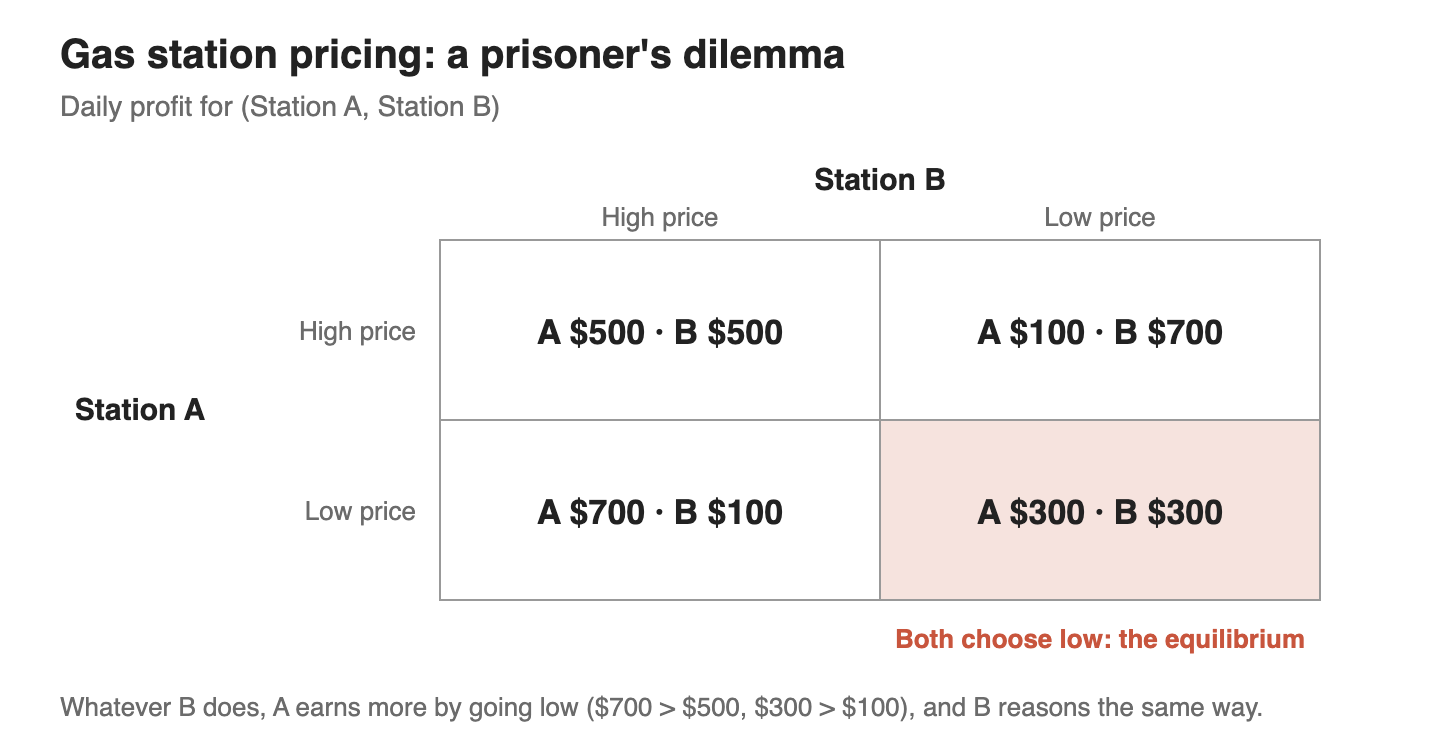
Put yourself in Station A's shoes. If B charges high, you earn $700 by going low versus $500 by staying high. If B charges low, you earn $300 by going low versus $100 by staying high. Either way, low pays more. Station B reasons exactly the same way.
So both charge low and earn $300 each, even though both would be better off at $500. Each made the smart move for themselves, and together they ended up worse off.
This pattern is called a prisoner's dilemma. The outcome where neither player can do better by changing only their own choice is called a Nash equilibrium, after the mathematician John Nash. Here, both charging low is the equilibrium, and it's worse for both of them than cooperating.
You can see the same structure in price wars, arms races, overfishing, and the group project where everyone hopes someone else will do the work.
How cooperation wins: repeat the game
Real life is rarely a single round. When the same players meet again and again, cooperation becomes possible, because today's choices affect tomorrow's.
Around 1980, the political scientist Robert Axelrod invited researchers to submit computer strategies for a repeated prisoner's dilemma tournament. The winner was one of the simplest: tit-for-tat. Cooperate on the first move, then copy whatever the other player did last time. It's nice (it never cheats first), it retaliates (it doesn't get exploited), and it forgives (it returns to cooperating as soon as the other player does).
Try it yourself
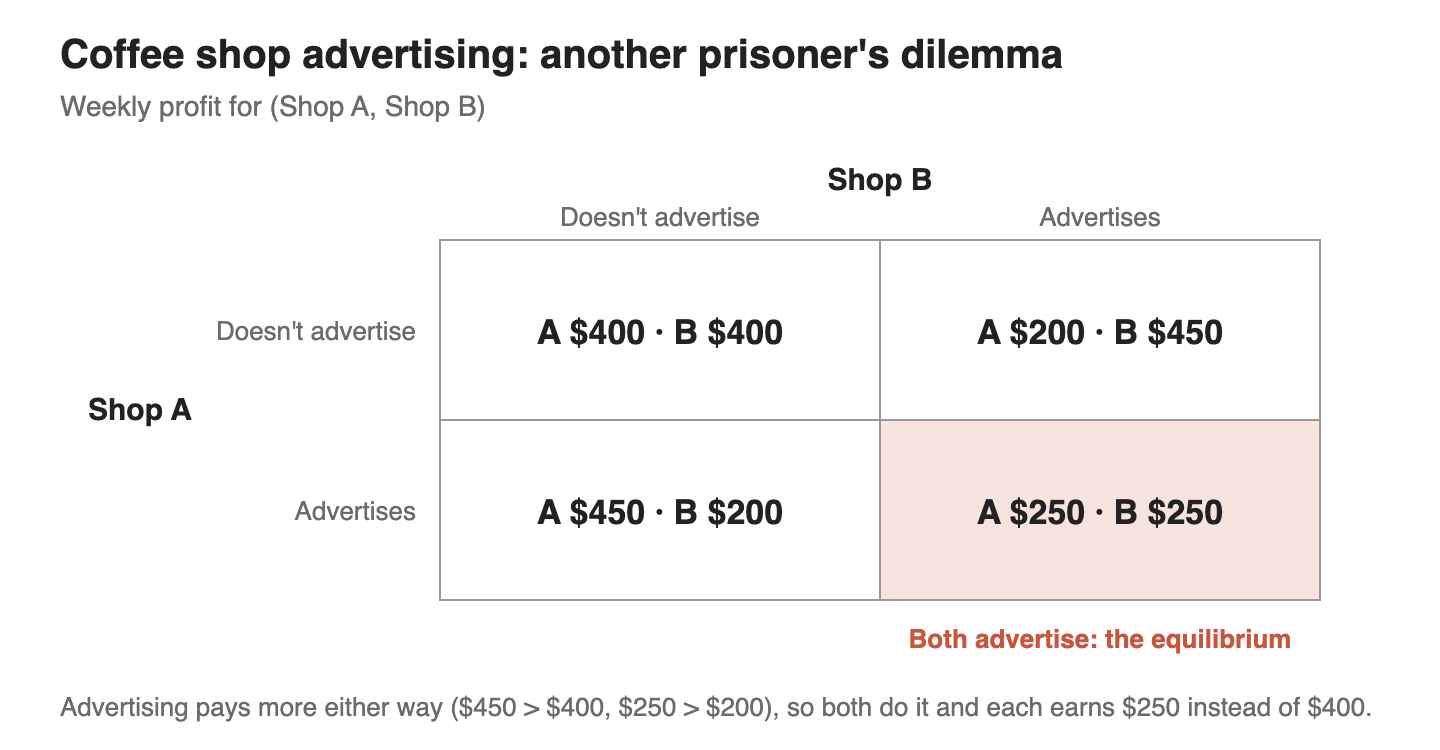
Two coffee shops on the same block each decide whether to advertise.
Neither advertises: each earns $400 a week.
Both advertise: each earns $250 (they pay for ads and still split the customers).
Only one advertises: the advertiser earns $450 and the other earns $200.
What will happen, and is it good for the shops?
Answer: If the other shop doesn't advertise, advertising pays more ($450 vs. $400). If the other shop does advertise, advertising still pays more ($250 vs. $200). So both advertise and earn $250 each, less than the $400 each they'd get if neither did. It's a prisoner's dilemma. The way out is a change in the game: an agreement both can trust, or a long relationship where cooperating pays off over time.
Go deeper
Dintersmith's Aftermath devotes a chapter to game theory, opening with students doing this math in real classrooms and closing with challenges to try yourself.
That's the last of the eight pillars. Return to the series introduction for the full list.