The IXL Portal
Skill-by-skill practice with instant feedback, and a plan built for GED math
IXL is an online practice platform used by schools across the country. Its specialty is focused, skill-by-skill practice: you pick one specific skill, answer questions that adjust to how you're doing, and get an explanation every time you miss one. The name is a play on "I excel."
For GED students, IXL's most useful feature is a skill plan that lines up its practice with the topics on the GED Mathematical Reasoning test.
Start here: IXL's GED Mathematical Reasoning skill plan. It lists every GED math topic with links straight to the matching IXL practice.
Closer to home: the Aquidneck Island Adult Learning Center in Newport has recently switched to IXL for its GED students, so learners there will see these same skills in class.
What IXL is
IXL launched in 2007 as a math practice site and has grown to cover math, English language arts, science, social studies, and Spanish, from pre-K through 12th grade. It's run by IXL Learning, a company that also owns Rosetta Stone. Most students use IXL through a school or program license; families can also buy a home membership.
How it works
Thousands of specific skills. Instead of a broad lesson on "fractions," IXL has separate skills for adding fractions, comparing fractions, word problems with fractions, and so on. You always know exactly what you're practicing.
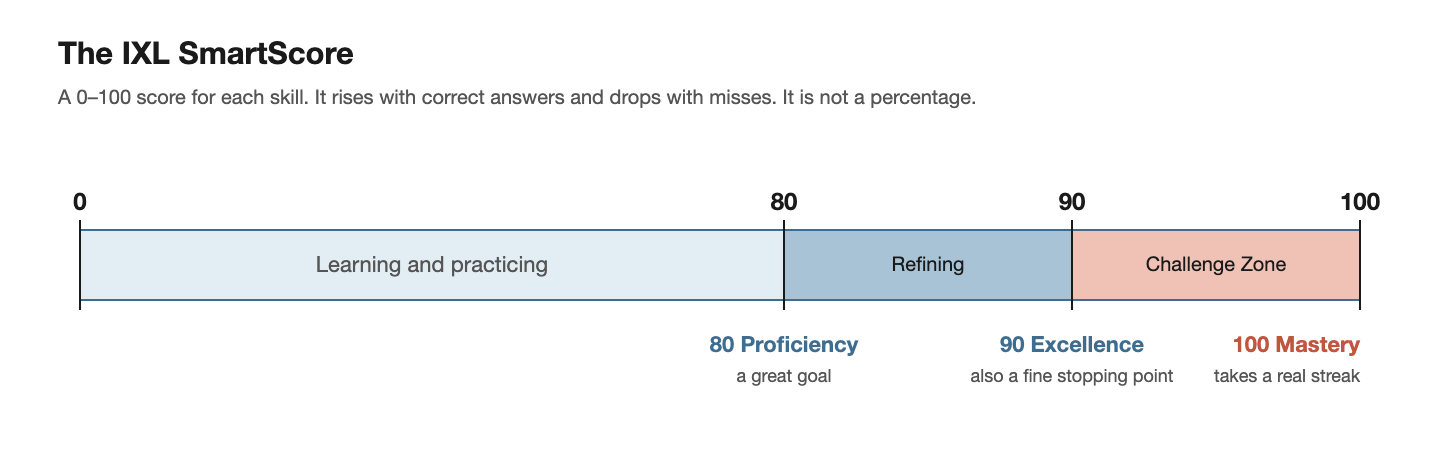
The SmartScore. Every skill has a score from 0 to 100. It isn't a percentage. It rises as you answer correctly and drops when you miss, with harder questions as you climb. IXL calls 80 proficiency, 90 excellence, and 100 mastery.
The Challenge Zone. Above 90, questions get tougher, correct answers earn fewer points, and a wrong answer costs more. Reaching 100 takes a real streak.
Explanations and videos. After a wrong answer, IXL shows a worked solution. Many skills also have short video tutorials.
The Real-Time Diagnostic. In about 45 minutes per subject, IXL estimates a student's level in math and English and builds a personal action plan of skills to work on next.
IXL and the GED
IXL publishes a GED Mathematical Reasoning skill plan that maps each GED math topic to matching IXL skills, from unit rates and percents to graphs, equations, and geometry. There's a matching plan for Reasoning Through Language Arts too. One note: IXL says these alignments are its own work and aren't endorsed by GED Testing Service. They're a practice guide, not official GED material.
Using IXL well
Aim for 80, not 100. IXL itself recommends 80 (proficiency) or 90 (excellence) as a good stopping point. Chasing 100 on every skill can turn practice into a grind.
Two skills a week. IXL's research suggests reaching 80 in at least two skills per week. Small, steady progress adds up.
Read the explanation every time you miss. That's where the learning happens. Racing to the next question wastes the mistake.
Take a break when the score drops. Losing points in the Challenge Zone is frustrating. Progress is saved, and a fresh start later usually goes better.
Pair it with thinking. IXL is excellent for practice and feedback. It's less good at open-ended problem solving and explaining why. A tutor, a teacher, or the GED Math resources on this site can fill that gap.
Try it yourself
Here's a GED-style problem like the ones in IXL's GED plan.
A phone plan costs $25 a month plus $0.10 for each international text. Last month's bill was $31.50. How many international texts were sent?
Answer: The texts cost $31.50 − $25 = $6.50. At $0.10 each, that's $6.50 ÷ $0.10 = 65 texts. As an equation: 25 + 0.10t = 31.50, so 0.10t = 6.50 and t = 65.
Explore
IXL: the main site
The GED Portal: how the GED works and where to start
Back to Test Readiness