The Khan Academy Portal
A free, world-class education for anyone, anywhere, and how to make the most of it for math
Khan Academy is a nonprofit whose mission is "a free, world-class education for anyone, anywhere." It is one of the most remarkable learning resources ever built, and every bit of its core platform costs nothing.
If you're a student, a parent, a teacher, or an adult who wants to finally understand the math you skipped, this is one of the best places in the world to start.
How it began
In 2004, Sal Khan, then a hedge fund analyst with degrees from MIT and Harvard, started tutoring his young cousin Nadia in math over the phone and the internet. Other relatives wanted help too, so he began recording short videos and posting them on YouTube. Strangers started watching. Some wrote to say the videos had changed how they felt about math.
In 2008 he turned the project into a nonprofit, and in 2009 he quit his job to work on it full time. What started as videos for one cousin is now a global classroom.
By the numbers
According to Khan Academy's own figures:
Available in more than 190 countries and more than 55 languages
232 million registered users
100 million learners in the 2025–26 school year alone
More than 840 courses, from kindergarten through early college
Khan Academy's own studies report learning gains of roughly 20 to 30 percent for students who spend 18 or more hours on the platform over a school year
What's there
Math, the heart of it all. Khan Academy began with math, and math is still its deepest collection. Courses run from early counting and arithmetic through pre-algebra, Algebra 1 and 2, geometry, trigonometry, precalculus, statistics and probability, AP Calculus, multivariable calculus, differential equations, and linear algebra. Every course is broken into units and skills, each with short videos, worked examples, and practice problems with hints and step-by-step solutions. There are also "Get ready" courses that review exactly what a student needs before starting a new class.
Test prep. Khan Academy is the official partner of College Board for SAT prep. Students take full-length adaptive practice tests in College Board's Bluebook app, then use Official Digital SAT Prep on Khan Academy to work on the exact skills they need, for free. See this site's SAT/PSAT section for more.
Much more than math:
Science: biology, chemistry, physics, earth and space science, and AP courses in each
English language arts: reading, vocabulary, and grammar from early grades through high school
Social studies and history: U.S. and world history, civics and government, art history
Economics and finance: micro- and macroeconomics, and personal finance
Computing: programming, computer science principles, and how the internet works
Life skills: money management, careers, and social-emotional learning
Khan Academy Kids. A free app for children ages 2 to 8, with stories, games, and early reading and math.
Khanmigo. Khan Academy's AI tutor. Instead of handing students answers, it's designed to ask guiding questions and coach them toward solving problems themselves, the same way a good tutor does. It also includes tools that help teachers plan lessons and track progress.
Tools for teachers and parents. Teachers can create classes, assign practice, set mastery goals, and see exactly where each student is stuck. Parents can follow their children's progress. All of it is free.
A math example: how a student uses it
Say a student is starting Algebra 1 and feels shaky. Here's a path that works:
Take the course challenge. It's a short test that covers the whole course and shows which skills the student already knows.
Pick one skill. For example, solving two-step equations like 3x + 5 = 20.
Watch the video, then practice. Each skill has a few short videos and a practice set. If a problem is hard, the hints walk through it step by step.
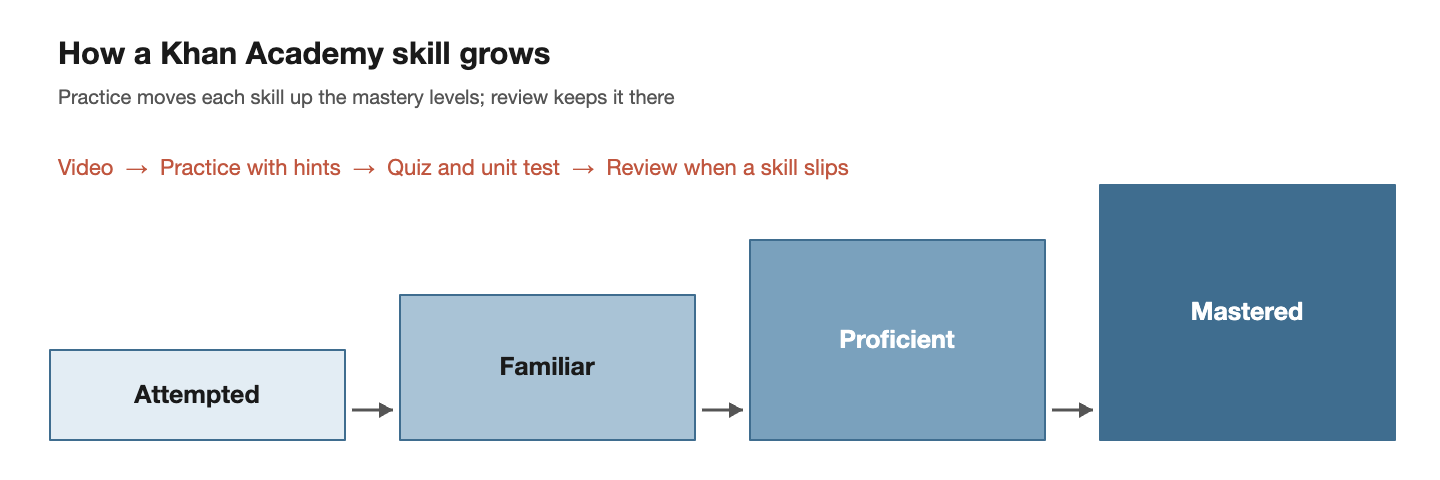
Climb the mastery levels. Every skill moves through Attempted, Familiar, Proficient, and Mastered. Unit quizzes and tests confirm that learning has stuck, and skills that are slipping come back for review.
Come back regularly. Khan Academy reports that students who use it for as little as 30 minutes a week gain significantly more than expected over a school year.
The key is consistency. A little practice every week, focused on one skill at a time, builds both knowledge and confidence.
Why it matters for math thinking
Khan Academy's real gift is that students can learn at their own pace. A student can rewatch an explanation five times without embarrassment, or race ahead when something clicks. Mastery-based practice means gaps don't get buried; they get found and filled. And because it's free, a student in Newport has exactly the same resource as a student in Nairobi or New Delhi.
It works best alongside a teacher, a tutor, or a parent who asks good questions. Khan Academy builds the skills; conversation builds the thinking.
Watch and explore
Let's use video to reinvent education: Sal Khan's 2011 TED talk on how Khan Academy began and what it could become
How AI could save (not destroy) education: his 2023 TED talk, with a live demonstration of Khanmigo
Khan Academy Math: every math course in one place
Official Digital SAT Prep: free SAT practice, built with College Board
About Khan Academy: mission, reach, and research
Sal Khan's books: The One World Schoolhouse (2012) and Brave New Words (2024), on AI and education
Back to Test Readiness