When 99% Accurate Means About 9% Likely
Why a positive result from a very good test can still mean you're probably fine
October 23, 2026
Suppose a test for a disease is “99% reliable.” It correctly flags 99% of people who have the disease, and it correctly clears 99% of people who don’t. You take the test and it comes back positive. What are the chances you actually have the disease?
Most people say 99%. Many doctors say the same. For a rare disease, the real answer is closer to 9%.
Run the numbers on a crowd
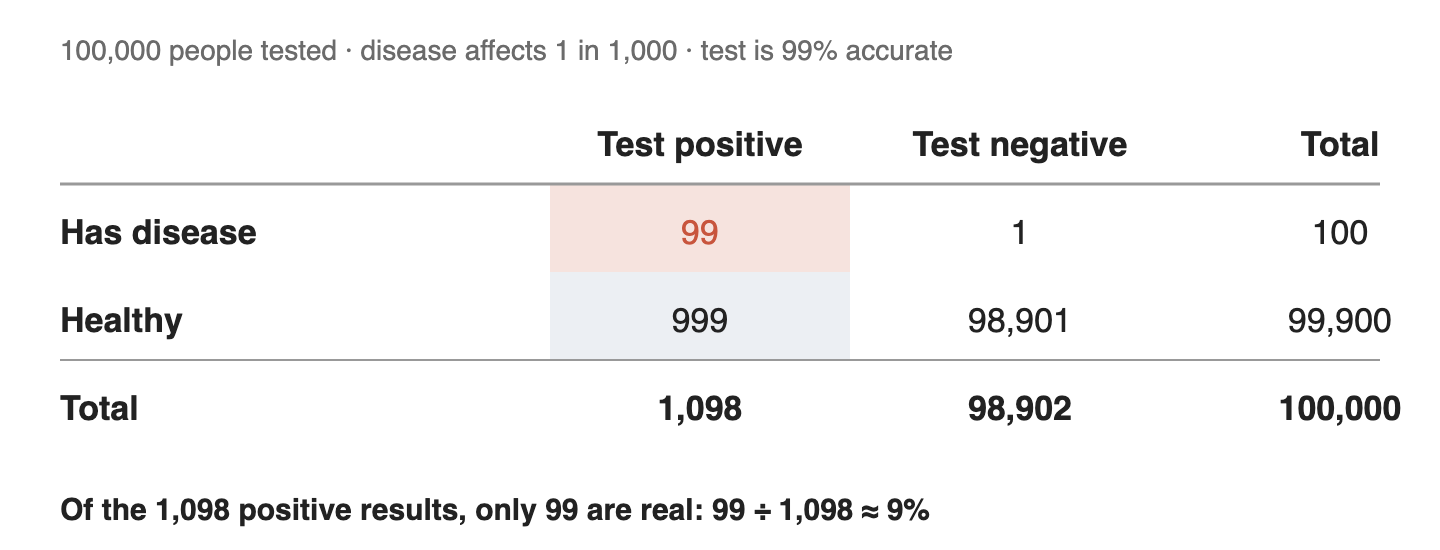
Abstract probabilities are hard to reason about, so picture actual people. Say the disease affects 1 in 1,000 people, and we test 100,000 of them.
100 people have the disease. The test catches 99% of them, so 99 test positive.
99,900 people are healthy. The test is wrong 1% of the time, so 999 healthy people also test positive.
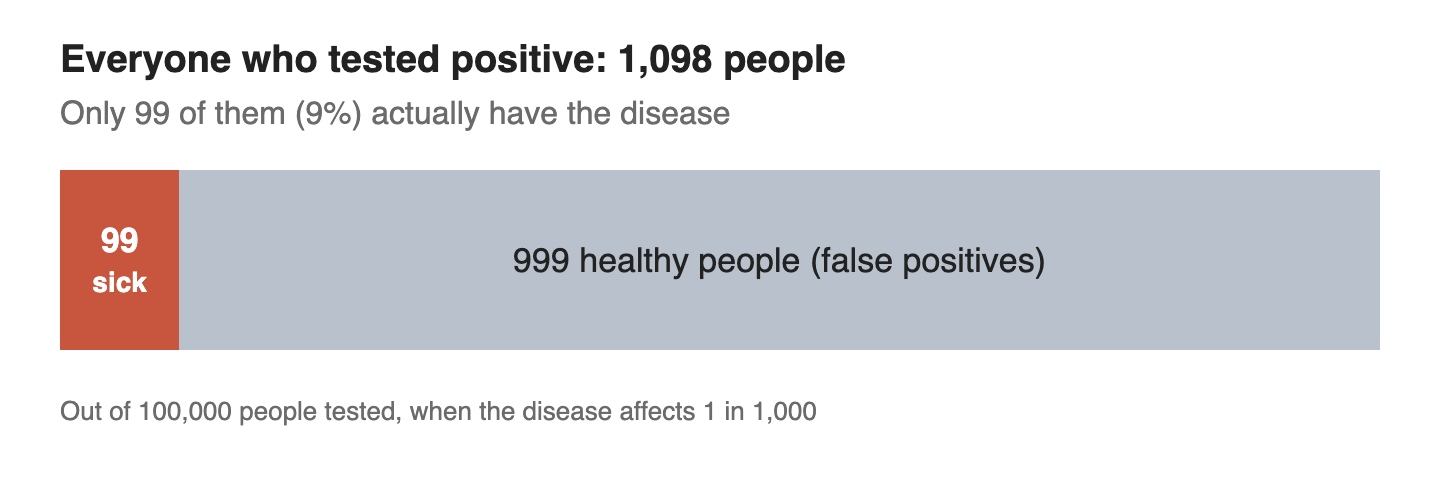
That gives 99 + 999 = 1,098 positive results. Only 99 of those people are actually sick.
99 ÷ 1,098 ≈ 9%
Why the intuition fails
The 1% error rate sounds small, but it applies to a very large group: the healthy majority. One percent of 99,900 is far larger than 99% of 100. The false positives swamp the true ones.
The mistake is answering a different question than the one asked. “99% accurate” tells you how likely a positive result is if you’re sick. What you want to know is how likely you are to be sick given a positive result. Those two numbers can be wildly different, and the gap between them depends entirely on how common the disease is to begin with. Statisticians call this the base rate, and ignoring it is the base rate fallacy.
The formal tool for getting it right is Bayes’ theorem, but the table above is Bayes’ theorem. It just shows the calculation with people instead of symbols.
What changes the picture
The same 99% test gives very different answers depending on who is being tested:
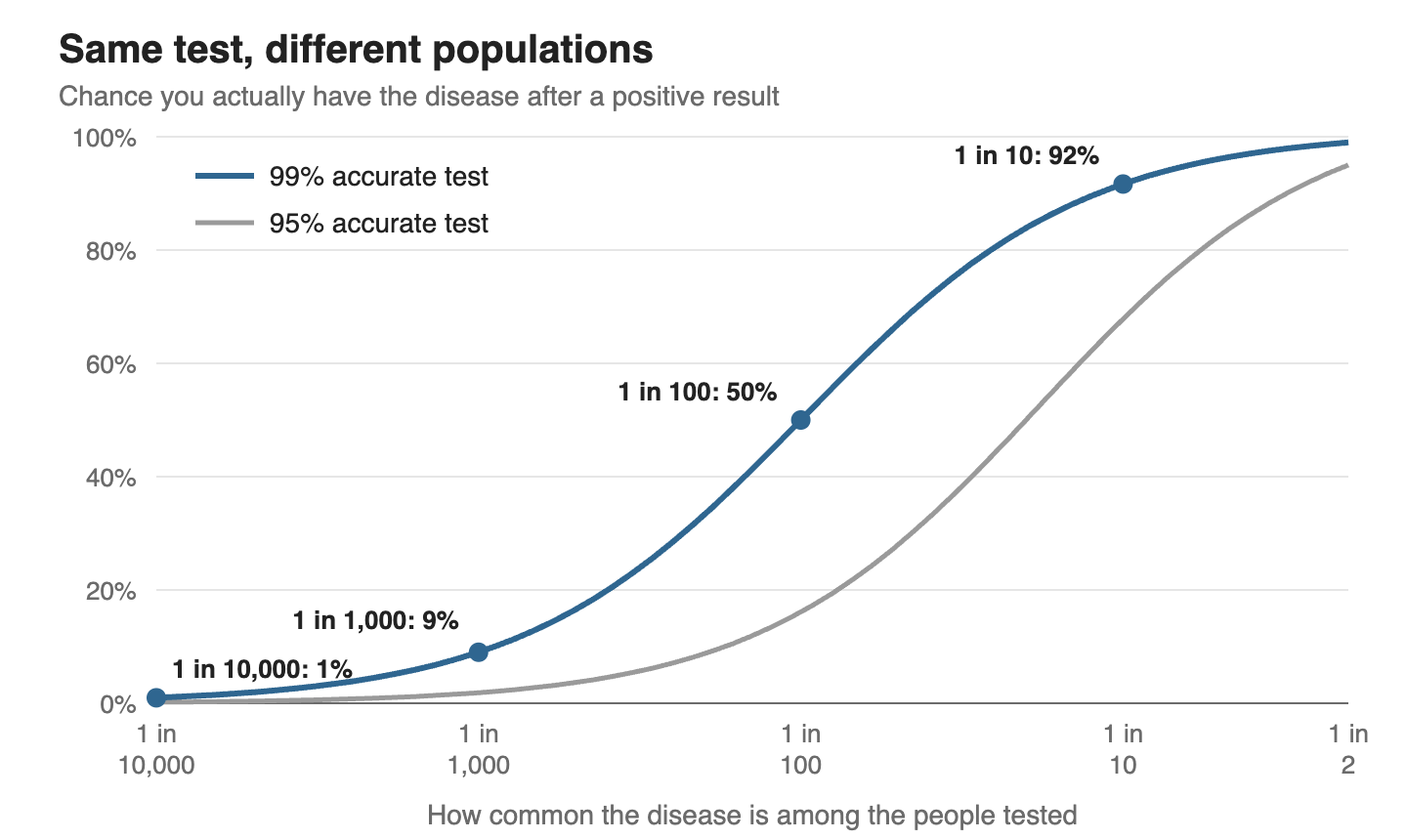
A more common disease. If 1 in 10 people had it, a positive result would mean about a 92% chance you’re sick. The test is the same; the population is different.
A second test. Retest the 1,098 positives. About 98 of the 99 sick people test positive again, but only about 10 of the 999 healthy people do. Now the odds are roughly 98 out of 108, or 91%. This is why a positive screening result is followed by a confirmatory test.
Who gets tested. Someone tested because they have symptoms belongs to a group where the disease is much more common than in the general public, so their positive result carries much more weight.
The takeaway
A test’s accuracy alone can’t tell you what a positive result means. You also need to know how common the condition is among the people being tested. When a condition is rare, most positives can be false even with a very good test.
Try it yourself
A test is 95% accurate in both directions, and the condition affects 1 in 200 people. You test positive. Build a table for 10,000 people and find the chance you actually have the condition.
(Answer: 50 people have it and 47.5 of them test positive; 9,950 don’t, and 497.5 of them test positive. 47.5 ÷ 545 ≈ 8.7%.)
Ted Dintersmith uses a mammogram version of this puzzle in his book Aftermath: The Life-Changing Math That Schools Won't Teach You (2026), where probability is one of eight kinds of math he argues every student should learn. For more, see the series The Math Schools Skip.