Pillar 5: Optimization
Getting the most from what you've got
October 23, 2026
Part 5 of 8 in a series on the eight "pillars" of useful math in Ted Dintersmith's book Aftermath: The Life-Changing Math That Schools Won't Teach You (2026). The framework is his; the explanations and practice problems are written for Math Thinking Coach. Read the series introduction.
Optimization means finding the best possible outcome when something is limited, whether that's money, time, materials, or attention. Every budget, schedule, and plan is an optimization problem, whether or not we call it that.
The fence problem
You have 100 feet of fencing and want to enclose the largest possible rectangular garden. What shape should it be?
The length plus the width must be 50 feet (half the perimeter). Try some options:
10 × 40 = 400 square feet
20 × 30 = 600 square feet
25 × 25 = 625 square feet
30 × 20 = 600 square feet
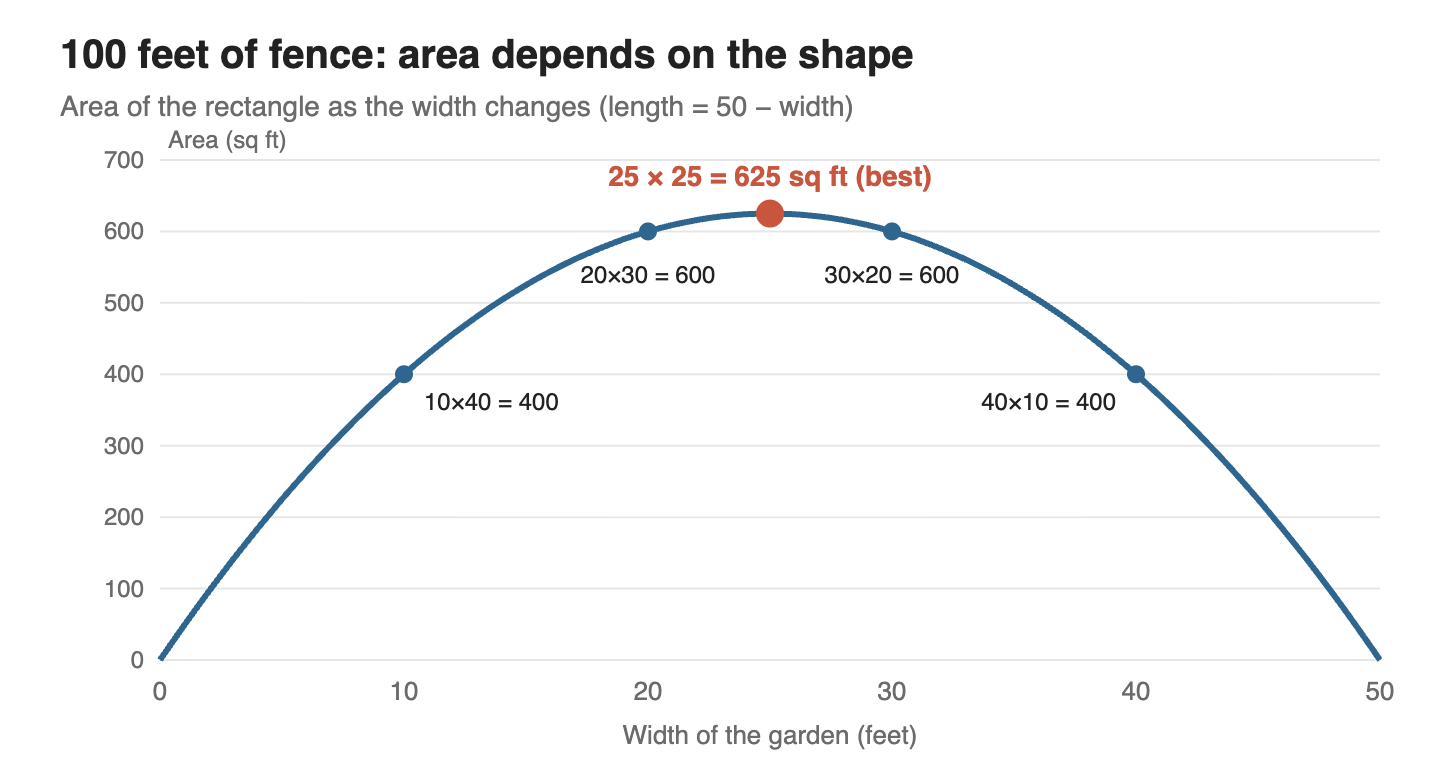
The square wins. Area rises, peaks, and falls as you change the width, and the best answer sits at the top of the curve.
Change the constraint, change the answer
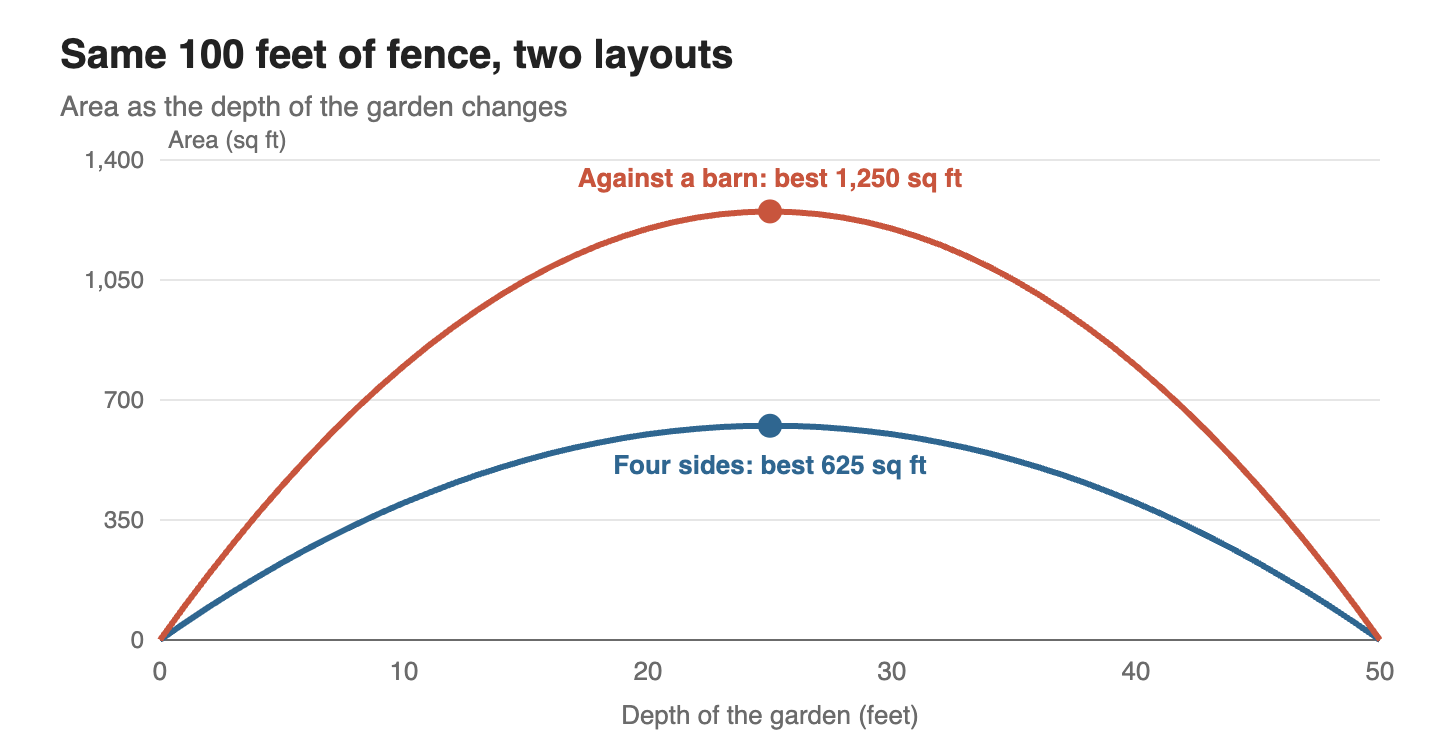
Now suppose the garden backs up against a barn, so the barn wall serves as one side and you only need fence for three sides. With the same 100 feet, the best garden is 25 feet deep and 50 feet long: 1,250 square feet, double the area.
That's the bigger lesson. Optimizing within the rules gained a little; questioning the rules (do we really need four sides of fence?) gained a lot. Good optimizers do both.
Spend the next hour where it does the most good
Most real optimization is about dividing a limited resource. Suppose you have 4 hours to study for a math test and a history test. Each extra hour helps, but less than the one before:
Math: the 1st hour adds 12 points, the 2nd 8, the 3rd 4, the 4th 2.
History: the 1st hour adds 10 points, the 2nd 7, the 3rd 5, the 4th 3.
The rule: give each hour to whichever subject gains the most from it right now. Hour 1 goes to math (+12), hour 2 to history (+10), hour 3 to math (+8), hour 4 to history (+7). Two hours each earns 37 points. Every other split does worse: all four hours on math earns only 26.
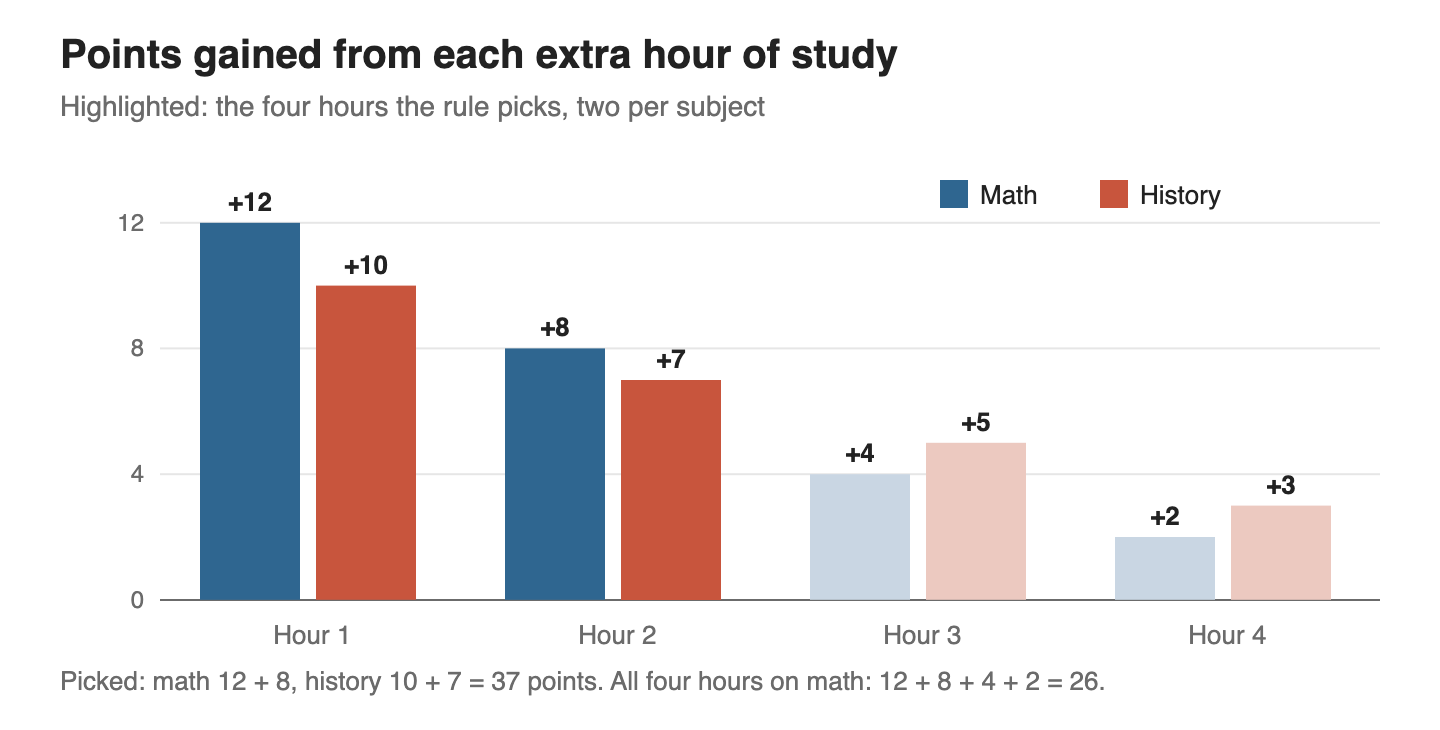
Economists call this thinking at the margin. It applies to budgets, training plans, and team rosters. Dintersmith describes students doing this kind of math with fantasy sports budgets and, in one Virginia school, with $10 seed grants they had to put to the best possible use in their community.
Try it yourself
You have 60 feet of fencing to build a rectangular pen against a barn wall (fence on three sides only). What dimensions give the largest area?
Answer: Let the two sides coming out from the barn be w feet each. The side parallel to the barn is 60 − 2w, so the area is w(60 − 2w). Testing values: w = 14 gives 14 × 32 = 448; w = 15 gives 15 × 30 = 450; w = 16 gives 16 × 28 = 448. The best pen is 15 feet deep and 30 feet long. As before, the side along the barn is twice the depth.
Go deeper
Dintersmith's Aftermath devotes a chapter to optimization, opening with students doing this math in real classrooms and closing with challenges to try yourself.
Next in the series: Pillar 6: Algorithms.