The SAT/PSAT Portal
How the digital SAT and PSAT work, what's on the math section, and the best free ways to prepare
The SAT and the PSAT are College Board's family of tests, together called the SAT Suite. They measure the reading, writing, and math that matter most for college and career, and they all share one score scale, so a PSAT score shows you roughly where you'd land on the SAT today.
This portal explains how the tests work, then takes you straight to the math: every skill on the test, with a post for each one, and the best free resources for practice.
The tests
SAT: usually taken in 11th and 12th grade, and used by many colleges in admissions. Scored from 400 to 1600: 200 to 800 for Reading and Writing, and 200 to 800 for Math.
PSAT/NMSQT and PSAT 10: the same test, scored from 320 to 1520. The PSAT/NMSQT is given in October, mostly to 11th graders; the PSAT 10 is given to 10th graders in the spring.
PSAT 8/9: for 8th and 9th graders, scored from 240 to 1440.
National Merit: the PSAT/NMSQT is the qualifying test for the National Merit Scholarship Program. The scores that count are usually from 11th grade. The PSAT 10 and PSAT 8/9 don't count toward National Merit.
How the digital SAT works
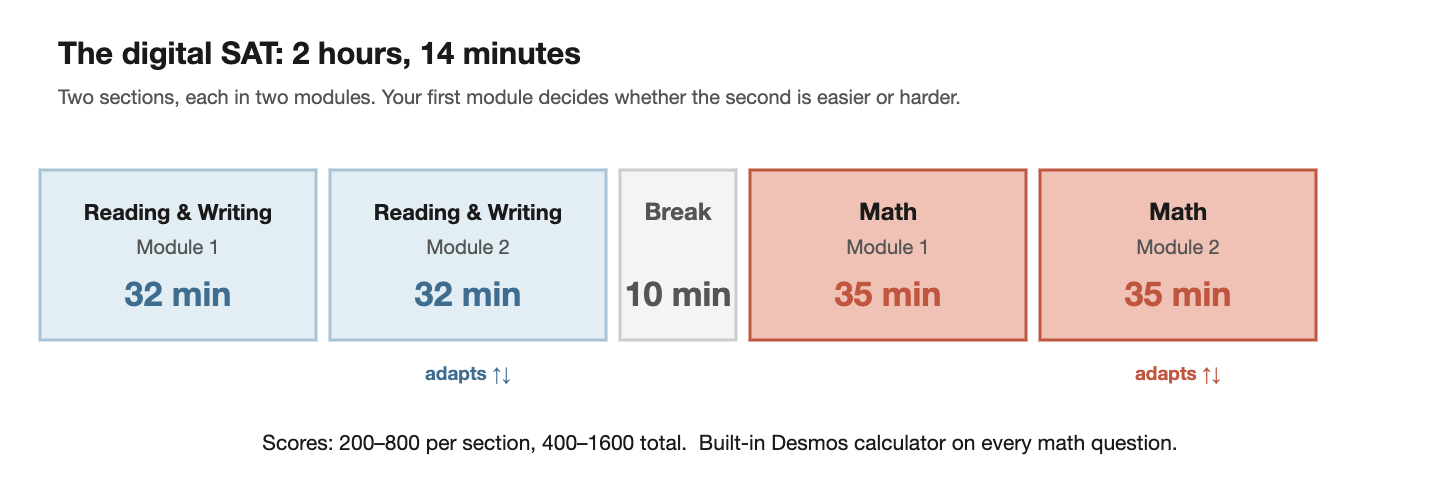
The SAT is taken on a laptop or tablet in College Board's Bluebook app. It has two sections:
Reading and Writing: 64 minutes, in two modules of 32 minutes
Math: 70 minutes, in two modules of 35 minutes
There's a 10-minute break between the sections, for a total of 2 hours and 14 minutes. The PSAT/NMSQT and PSAT 10 follow the same structure.
The test is adaptive. The first module of each section has a mix of easy, medium, and hard questions. How you do on it decides whether your second module is easier or harder. A strong first module matters, so start carefully, not fast.
Tools on test day: Bluebook has a built-in Desmos graphing calculator you can use on every math question (or you can bring your own approved calculator), a reference sheet of common formulas, a timer, and a way to flag questions to come back to. Learn the calculator before test day; see the Desmos Portal.
Benchmarks: College Board's college-readiness benchmarks for the SAT are 530 in Math and 480 in Reading and Writing.
How scoring works (approximately)
The basics. Each section is scored from 200 to 800, and the two add up to your total. There's no penalty for wrong answers, so answer every question, guessing if you must.
Not every question counts. Each module includes two pretest questions that College Board is trying out for future tests. They aren't scored, and you can't tell which ones they are. In Math, each module has 22 questions, and 20 of them count. In Reading and Writing, each module has 27 questions, and 25 count.
Which questions you get right matters, not just how many. The SAT uses a method called item response theory, which weighs each question's difficulty. College Board says two students who answer the same number of questions correctly can earn different scores. So any "number correct" chart is an estimate.
Module 1 opens the door. Everyone gets the same mixed first module. A strong first module routes you to a harder second module, and only the harder route leads to the highest scores. College Board's own chart shows the easier route topping out a little above the Math benchmark of 530. College Board doesn't publish the exact cutoff. A reasonable rule of thumb is that you need about two-thirds of module 1 right, roughly 15 of 22, to be routed to the harder module.
Math: about how many right for each score
These estimates come from the conversion table in College Board's printable SAT Practice Test 11, scaled from its 27-question modules to the real test's 22-question modules. Treat them as targets, not guarantees: your actual score depends on which questions you get right.
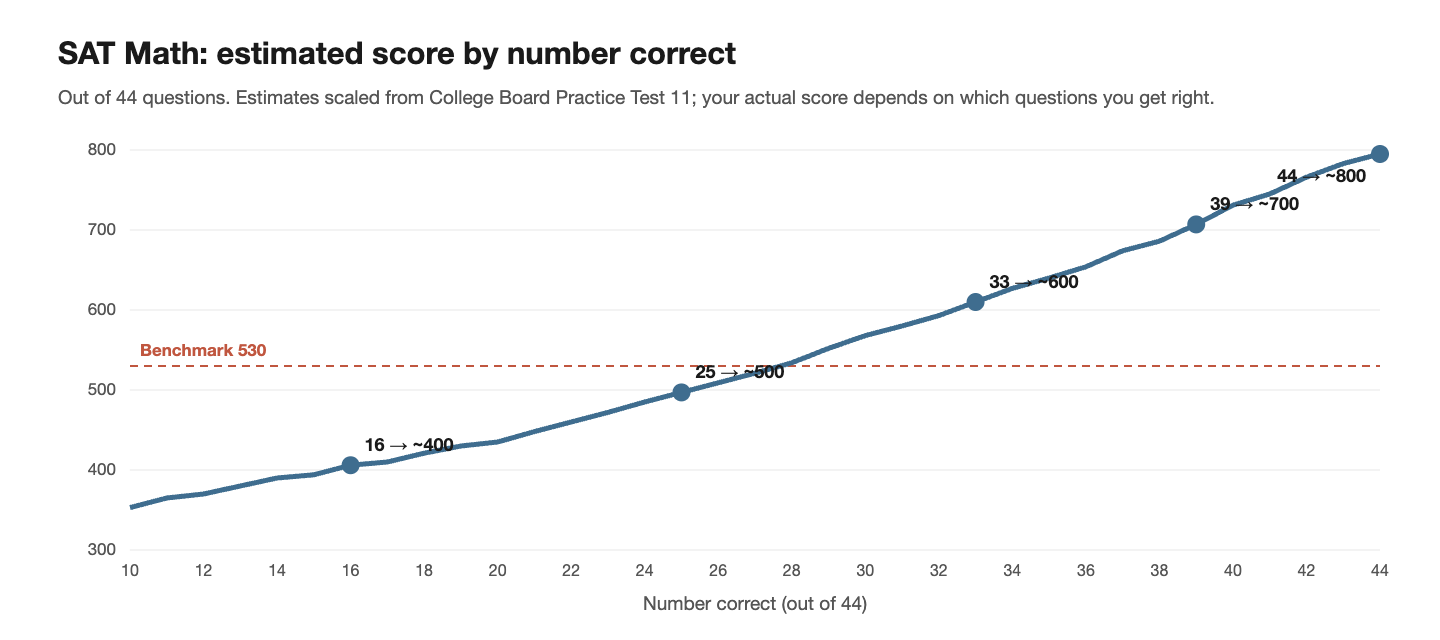
About 400: 16 correct out of 44, about 8 in each module
About 450: 21 correct, about 11 in module 1 and 10 in module 2
About 500: 25 correct, about 13 and 12
About 530 (the college-readiness benchmark): 28 correct, about 14 in each
About 600: 33 correct, about 17 in module 1 and 16 in a harder module 2
About 650: 36 correct, about 18 in each
About 700: 39 correct, about 20 and 19
About 750: 42 correct, about 21 in each
800: all or nearly all 44 correct
What this means in practice: module 1 decides which scores are possible. A student aiming for 600 or higher needs a strong module 1, roughly 16 or more out of 22, to reach the harder second module. Slow down on module 1 and check your work. Careless errors there cost the most.
Reading and Writing works the same way: a strong first module opens up the higher range of scores.
What's on the math section
Every math question tests one of 19 skills in four categories. Each skill below has its own post on this site: what the skill is, a worked SAT-style problem, where you'll use it in real life, the most common trap, and links to free practice. For the full map with a short check-in quiz, see the SAT Math Skill Map.
Algebra (about 35% of the test)
Advanced Math (about 35%)
Problem-Solving and Data Analysis (about 15%)
One-variable data: distributions and measures of center and spread
Evaluating statistical claims: observational studies and experiments
Geometry and Trigonometry (about 15%)
The best free practice
All of the official practice is free:
Bluebook practice tests: full-length, adaptive practice tests in the same app you'll use on test day. Afterward, your score report shows which skills to work on. Download Bluebook from College Board.
Khan Academy: College Board's official partner for SAT prep. Its Official Digital SAT Prep course has practice for every skill at three levels. See the Khan Academy Portal.
The SAT Suite Question Bank: College Board's searchable bank of real practice questions, sortable by skill and difficulty, at satsuitequestionbank.collegeboard.org.
A good way to prepare
Take a Bluebook practice test. It's the most accurate picture of where you stand.
Find your weakest category on the score report.
Work one skill a week. Read the skill's post here, then practice on Khan Academy until you reach Proficient.
Practice with Desmos. Many questions can be checked, or even solved, by graphing.
Take another practice test every few weeks to measure progress.
Small, steady effort beats cramming. Fifteen to twenty minutes most days adds up.
Try it yourself
If 3x + 7 = x + 19, what is the value of 4x?
Answer: Subtract x from both sides: 2x + 7 = 19. Subtract 7: 2x = 12, so x = 6, and 4x = 24. Notice that the question asks for 4x, not x. Answering 6 is one of the SAT's most common traps: always check what the question is actually asking for.
Back to Test Readiness