The Brilliant Portal
Learn math by doing: interactive lessons and puzzles that build real understanding
Brilliant is an online learning platform for STEM: science, technology, engineering, and math. What sets it apart is that it is fully interactive. Instead of watching videos or reading long explanations, you learn by working through short, visual problems yourself, on the web or in its phone app.
Brilliant describes its mission as creating "a world of great problem solvers." Its big idea is simple: you learn math by doing math, not by watching someone else do it. There are no lecture videos on Brilliant. Every lesson is a sequence of small, visual, hands-on problems: drag a slider, balance a scale, rearrange a shape, make a prediction, and get instant feedback on your thinking.
If Khan Academy is a free library where you can learn almost anything, Brilliant is more like a puzzle-filled workshop where you build intuition one step at a time. The two work well together.
How it began
Brilliant was founded in 2012 by Sue Khim, who studied mathematics at the University of Chicago and still runs the company as CEO. She has said that she learned math best by tinkering with interesting problems rather than watching lectures, and she built Brilliant around that experience. In 2013 Forbes named her to its 30 Under 30 list in education. Brilliant says more than 10 million people now learn on the platform.
What learning on Brilliant looks like
Bite-sized lessons. Brilliant suggests about 15 minutes a day. Each lesson is a short chain of problems, each one building on the last.
Visual and interactive. Concepts are shown, not just told. You manipulate diagrams, graphs, and models and see what changes.
Instant feedback. When you go wrong, you find out right away, with a short explanation of why.
Personalized practice. Brilliant adjusts to what you've mastered and what still needs work.
For a wide range of learners. Brilliant's math courses are built for grades 4 through 12, college students, and adults.
What's there
Math, the heart of the platform. Brilliant's math courses run from foundational number sense and algebra through geometry, functions, probability, and calculus, along with logic and puzzle courses that are pure fun.
Beyond math:
Data analysis: reading charts, statistics, and reasoning with real data
Computer science and programming: thinking like a programmer, Python, and algorithms
AI: how machine learning and large language models work
Science and engineering: physics and other topics, taught the same hands-on way
Daily puzzles. Short problems to keep the habit going.
What it costs
Brilliant is a for-profit company with a free tier and a paid Premium subscription. You can start for free, including the first chapter of any course and daily puzzles. Premium unlocks every course, personalized practice, and Brilliant's AI tutoring, with individual and family plans. Prices change and sales are frequent, so check brilliant.org for the current offer.
For teachers: through a grant-funded program called Brilliant for Educators, eligible K–12 teachers can get free Premium access for their classrooms. Students can't apply on their own; their teacher applies for the class.
A note on the evidence
Brilliant often says that interactive learning has been shown to be six times more effective than watching lecture videos. That figure comes from a study of online courses comparing students who learned by doing with students who mostly watched videos and read. It supports the general idea behind Brilliant, but it isn't a study of Brilliant itself. The principle is sound and matches decades of research on active learning: people learn more when they wrestle with problems than when they watch someone else solve them.
Brilliant and Khan Academy
Even Brilliant's own comparison page suggests Khan Academy for families who need broad, free support across many school subjects. Brilliant's strength is different: deep, intuitive understanding built through active problem solving. A good combination for a student is Khan Academy for coursework and test prep, and Brilliant for building the kind of intuition that makes the coursework click. See the Khan Academy Portal.
Try it yourself
Here's a classic logic puzzle in the spirit of Brilliant's daily challenges.
Three boxes sit on a table. One is labeled Apples, one Oranges, and one Apples and Oranges. Every label is wrong. You may reach into one box, without looking, and pull out a single piece of fruit. From that one piece, how can you correctly relabel all three boxes?
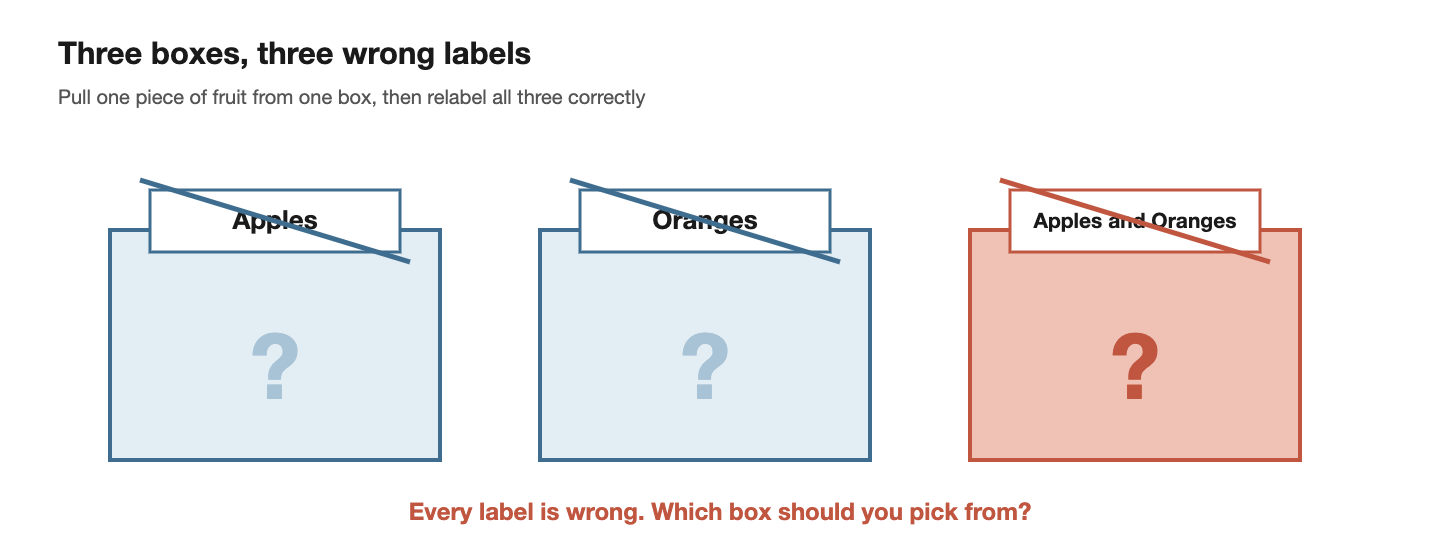
Answer: Reach into the box labeled Apples and Oranges. Because its label is wrong, it must hold only one kind of fruit. Say you pull out an apple: that box is the Apples box. Now the box labeled Oranges can't be oranges (its label is wrong) and can't be apples (you just found them), so it must be the mixed box. The last box, labeled Apples, must be the oranges. If you had pulled out an orange instead, the same reasoning works in reverse.
The key move is choosing the box that gives you the most information, which is exactly the kind of thinking Brilliant is built to develop.
Explore
Brilliant: start here; your first lessons are free
Brilliant Math: an overview of the math courses
Brilliant for Educators: free Premium for eligible K–12 classrooms
Why Brilliant: Brilliant's own comparisons with Khan Academy, IXL, and others
Back to Thinking with Numbers