Pillar 7: Decision Analysis
Making good choices when you can't know how things will turn out
October 23, 2026
Part 7 of 8 in a series on the eight "pillars" of useful math in Ted Dintersmith's book Aftermath: The Life-Changing Math That Schools Won't Teach You (2026). The framework is his; the explanations and practice problems are written for Math Thinking Coach. Read the series introduction.
A good decision can turn out badly, and a bad decision can get lucky. Decision analysis separates the quality of a choice from the luck of its outcome. It gives you a way to decide well before you know what will happen.
Expected value
You're buying an $800 laptop. At the register you're offered a two-year extended warranty for $150. Should you take it?
Lay out what could happen. Suppose there's about a 10% chance the laptop needs a $400 repair in those two years, and a 90% chance it doesn't.
Buy the warranty: you pay $150 no matter what.
Skip it: you pay $400 with probability 0.10, and $0 with probability 0.90. Your expected cost is 0.10 × $400 = $40.
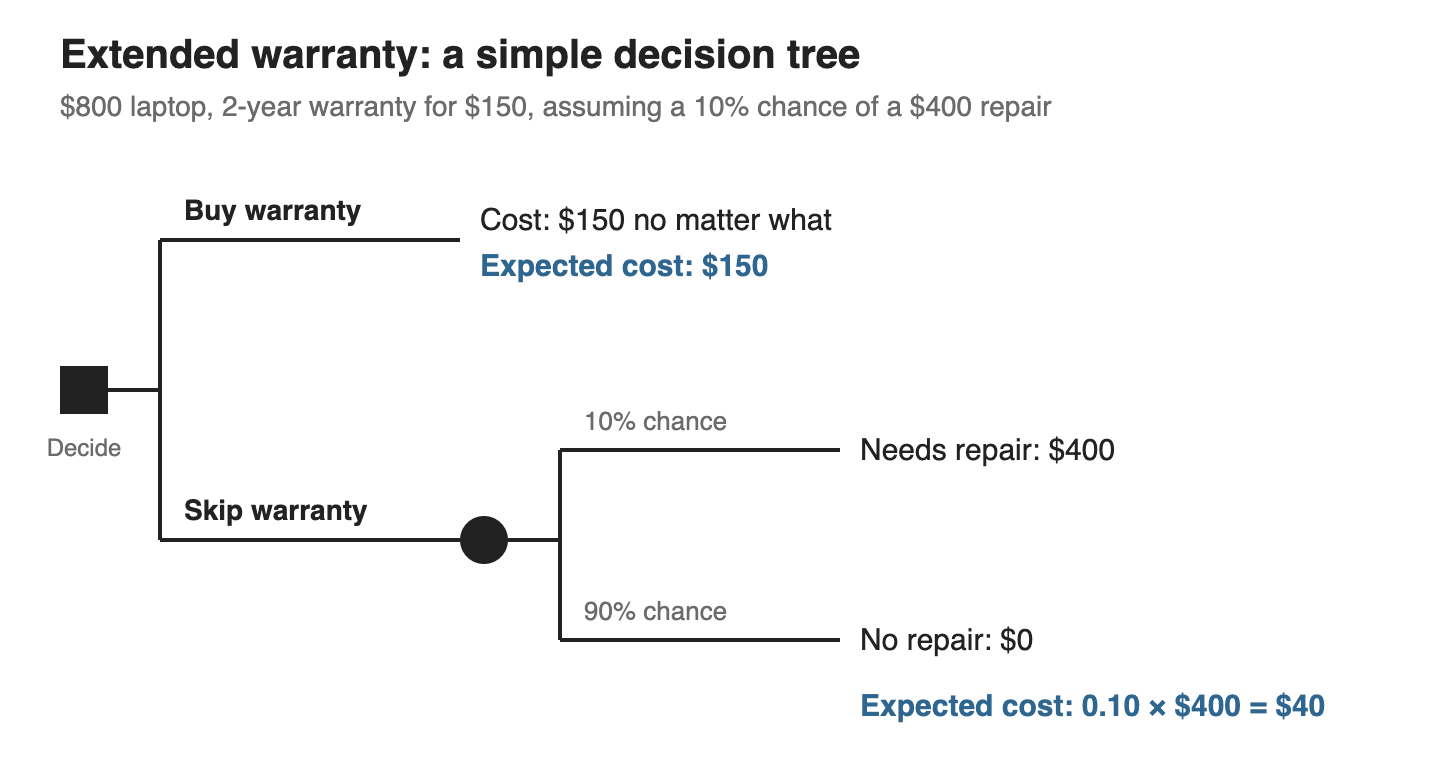
On average, the warranty costs you $150 to avoid $40 of expected repairs. That gap isn't an accident: warranties are priced so the seller profits on average.
Expected value isn't everything
So should no one ever buy insurance? Not quite. Expected value tells you what happens on average over many decisions. But if a $400 surprise would mean missing rent, protecting yourself against that one bad outcome can be worth paying extra for. That's why people insure their homes: the policy loses money on average, but it protects against a loss that would be ruinous.
The full method has five steps:
List your options.
List the possible outcomes of each.
Estimate how likely each outcome is.
Put a value on each outcome, in dollars or in what matters to you.
Compute, then check the result against your values and how much risk you can afford.
When one branch is a catastrophe
Dintersmith applies this thinking to a decision far more serious than a warranty: whether to get into a car with a driver who has been drinking. On one side is the awkwardness of saying no or finding another ride. On the other is a small chance of an outcome that can never be undone. When one possible result is catastrophic and permanent, even a small probability should dominate the decision. Laying the choice out ahead of time makes it much easier to make the right call in the moment.
Try it yourself
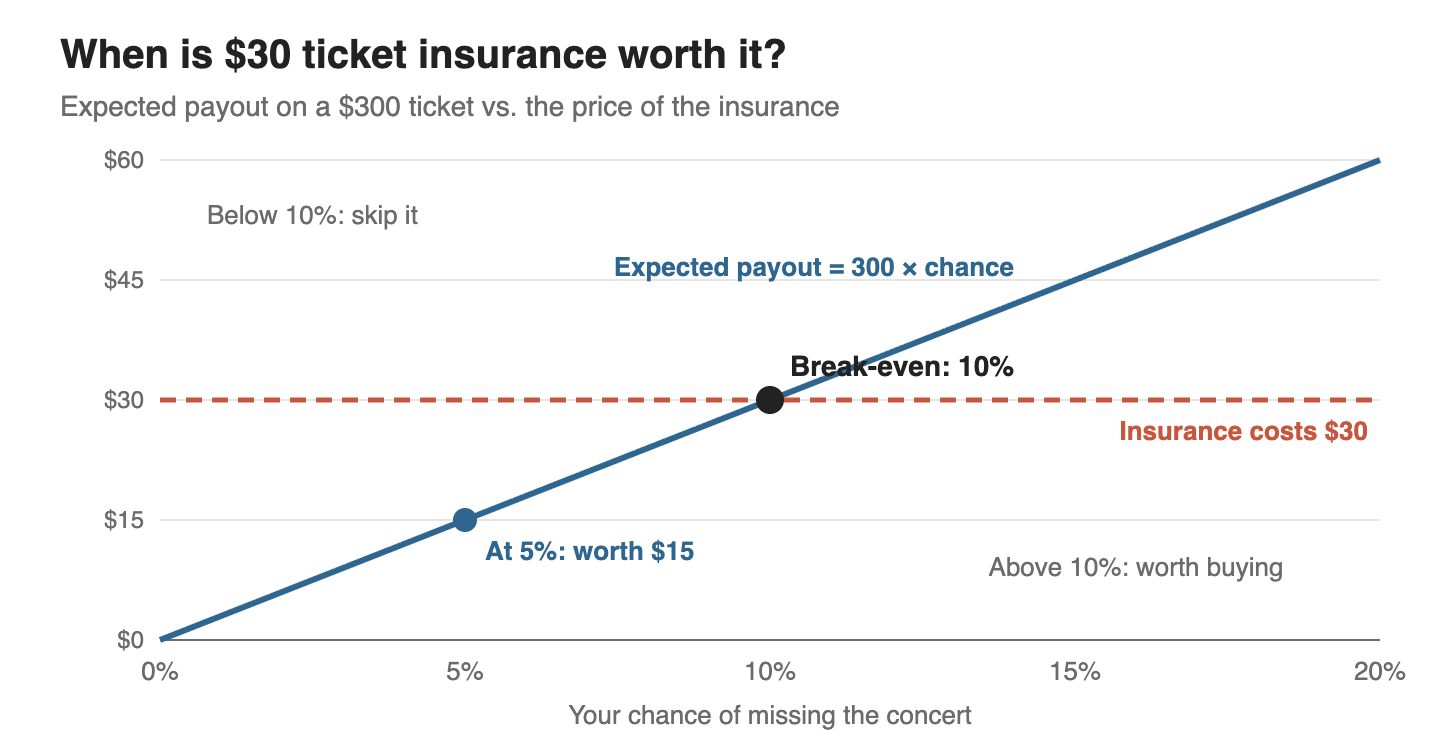
You've bought a $300 concert ticket. For $30, you can buy insurance that refunds the ticket if you can't attend. You figure there's about a 5% chance something will keep you away. Is the insurance a good deal? At what chance of missing the concert would it break even?
Answer: The expected payout is 0.05 × $300 = $15, but the insurance costs $30, so on average it's a bad deal. It breaks even when the chance of missing is $30 ÷ $300 = 10%. If your odds of missing are higher than that, or losing $300 would really hurt, the insurance starts to make sense.
Go deeper
Dintersmith's Aftermath devotes a chapter to decision analysis, opening with students doing this math in real classrooms and closing with challenges to try yourself.
Next in the series: Pillar 8: Game Theory.