The TED-Ed Portal
Short animated lessons that spark curiosity, including some of the best math riddles anywhere
TED-Ed is the education arm of TED, the nonprofit famous for TED Talks. Its mission is to spark and celebrate the ideas of teachers and students around the world. Its best-known work is a library of short animated lessons, most under ten minutes, each written by an educator or expert and brought to life by a professional animator. Everything is free.
How it began
TED-Ed launched in 2012 as TED's youth and education initiative. The idea was simple: take a great lesson from a great teacher, pair it with a talented animator, and share it with the world. TED reports more than 1,600 TED-Ed animations published, more than 5 billion views, and more than a million educators using TED-Ed in their classrooms.
What a TED-Ed lesson looks like
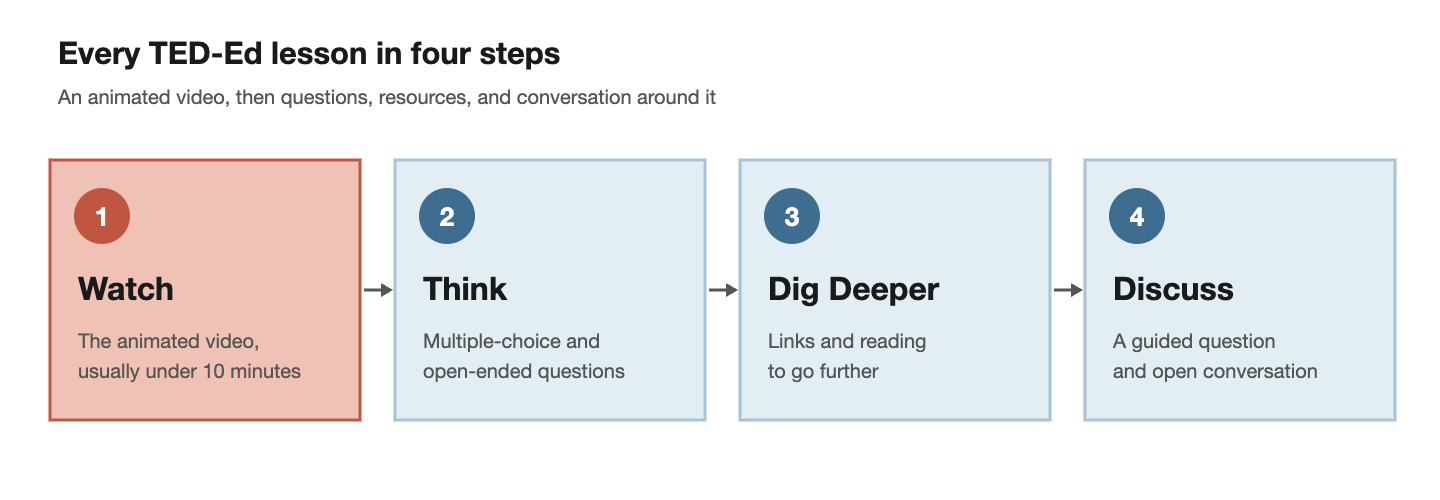
Every animation on ed.ted.com comes wrapped in a short lesson with four parts:
Watch: the animated video
Think: a few multiple-choice and open-ended questions to check understanding
Dig Deeper: links and reading for anyone who wants to go further
Discuss: a guided discussion question and a space for conversation
Teachers can also build their own lessons around any TED-Ed animation, TED Talk, or YouTube video, adding their own questions and assigning them to a class.
Beyond math
TED-Ed covers almost everything: science, history, literature, psychology, health, economics, art, and more. The animations are short enough to watch in a spare moment and rich enough to start a real conversation.
TED-Ed also runs Student Talks, a program that helps students develop and give their own TED-style talks, and Educator Talks for teachers.
The math riddles
For Math Thinking Coach, TED-Ed's real treasure is its riddle series. Each one tells a story: you're trapped, or a city is in danger, or a logician needs your help. The only way out is careful reasoning. Pause the video when the narrator says so, try to solve it yourself, then watch the solution.
They're a perfect example of what this site is about: problems that are fun, that reward patience over speed, and that build real mathematical thinking. A few favorites to start with:
Can you solve the prisoner hat riddle? by Alex Gendler: a classic about information and clever signaling
Can you solve "Einstein's Riddle"? by Dan Van der Vieren: a famous logic grid puzzle
Can you solve the giant cat army riddle? by Dan Finkel: arithmetic, strategy, and a mad scientist
Can you solve the logician's rave riddle? by Edwin Meyer: pure logic
Can you solve the feeding frenzy riddle? by Henri Picciotto: a puzzle from Numberland's best detective
How to use them
Pause and really try. The value is in the struggle, not the solution. Give yourself at least ten minutes before you watch the answer.
Solve with someone. These riddles are wonderful for a family dinner, a classroom, or a tutoring session. Talk through your reasoning out loud.
Use the Think and Discuss questions on ed.ted.com to check your understanding and see how others reasoned.
Ask "what if?" Change one detail of the riddle and see whether the solution still works. That's how mathematicians play.
Try it yourself
Here's a classic in the same spirit.
You stand before two doors. One leads to freedom, the other to a dungeon. Each door has a guard. One guard always tells the truth and the other always lies, but you don't know which is which. You may ask one guard one question. What do you ask?
Answer: Point at either guard and ask, "If I asked the other guard which door leads to freedom, which door would he point to?" Then take the other door. If you asked the truth-teller, he truthfully reports the liar's wrong answer. If you asked the liar, he lies about the truth-teller's right answer. Either way, the door they point to is the dungeon.
Explore
TED-Ed: lessons, animations, and teacher tools
TED-Ed on YouTube: every animation, including the full riddle series
Back to Thinking with Numbers