Pillar 3: Probability
Dice, bets, and why the house always wins
October 23, 2026
Part 3 of 8 in a series on the eight "pillars" of useful math in Ted Dintersmith's book Aftermath: The Life-Changing Math That Schools Won't Teach You (2026). The framework is his; the explanations and practice problems are written for Math Thinking Coach. Read the series introduction.
Probability is the math of uncertainty. It won't tell you what will happen next, but it tells you what to expect over many tries, and that's enough to make much better decisions.
Count the ways
Roll two dice. There are 6 × 6 = 36 equally likely outcomes. A sum of 7 can happen six ways (1+6, 2+5, 3+4, 4+3, 5+2, 6+1), so its probability is 6/36 = 1/6. A sum of 2 or 12 can happen only one way each: 1/36.
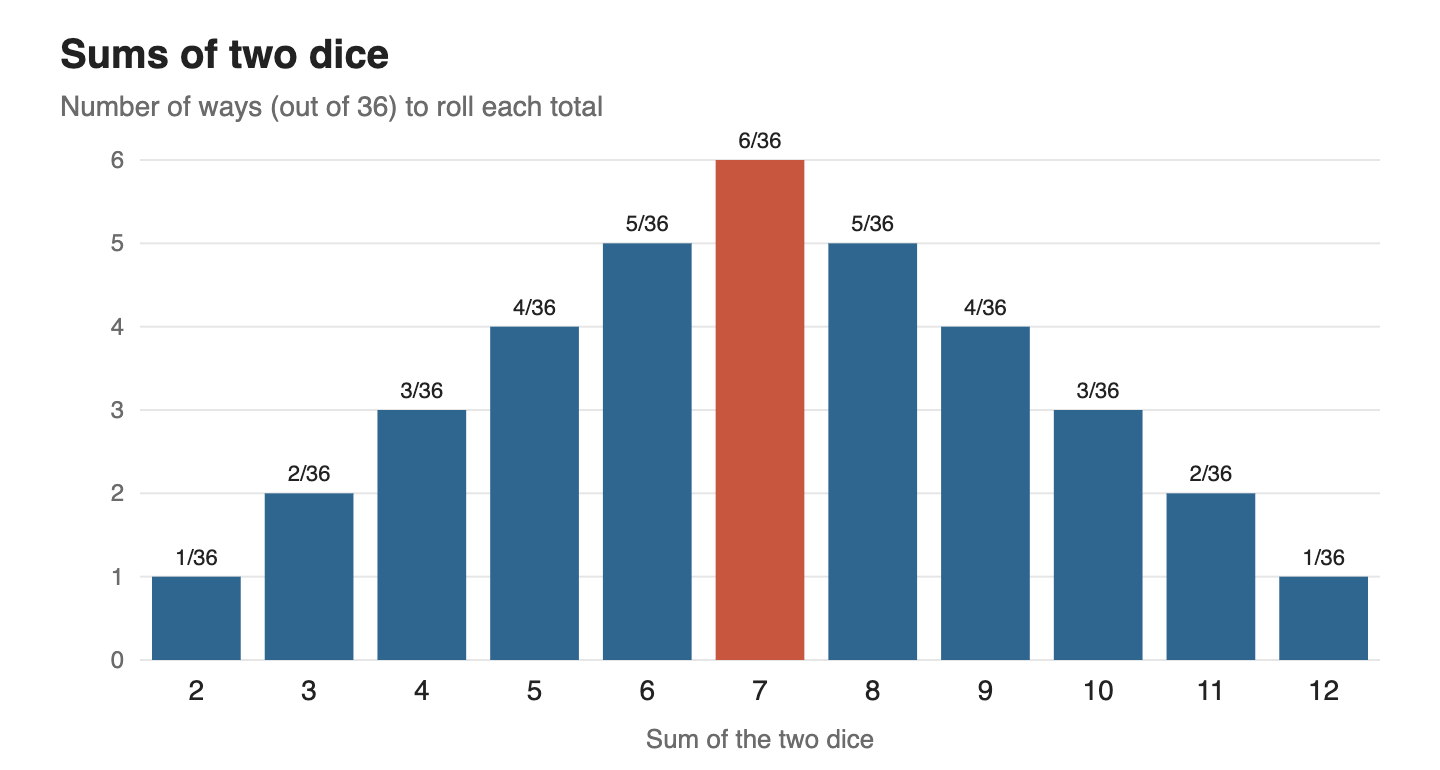
That's why 7 is the key number in craps. The basic move in probability is to list the equally likely outcomes and count the ones you care about.
The gambler's fallacy
A fair coin lands heads five times in a row. What's the chance the next flip is heads? Still 50%. The coin has no memory.
It feels like tails is "due," and that feeling has cost people fortunes. At the Monte Carlo Casino in 1913, a roulette wheel landed on black 26 times in a row. Gamblers kept betting heavily on red, sure a correction was coming. Each spin was still close to a coin flip.
Expected value: why the house always wins
An American roulette wheel has 38 pockets: 18 red, 18 black, and 2 green. Bet $1 on red:
You win $1 with probability 18/38.
You lose $1 with probability 20/38.
Your expected value per bet is 18/38 − 20/38 = −2/38, or about −5.3 cents per dollar. On any single spin you might win. Over thousands of spins, the casino keeps about a nickel of every dollar wagered, as reliably as a law of physics.
Sports betting works the same way. A typical line asks you to risk $110 to win $100. To break even you must win 110 ÷ 210 ≈ 52.4% of your bets. Someone who picks winners exactly half the time loses about 4.5% of everything they wager. Dintersmith points to the flood of sports-betting ads aimed at young people as one of the clearest reasons this math belongs in school.
When the question flips
Some of the most important probability questions are conditional: given that one thing happened, how likely is another? A medical test can be 99% accurate and still leave a positive result meaning only about a 9% chance of disease. Dintersmith uses a mammogram version of this puzzle in the book. We worked through it step by step in When 99% Accurate Means About 9% Likely.
Try it yourself
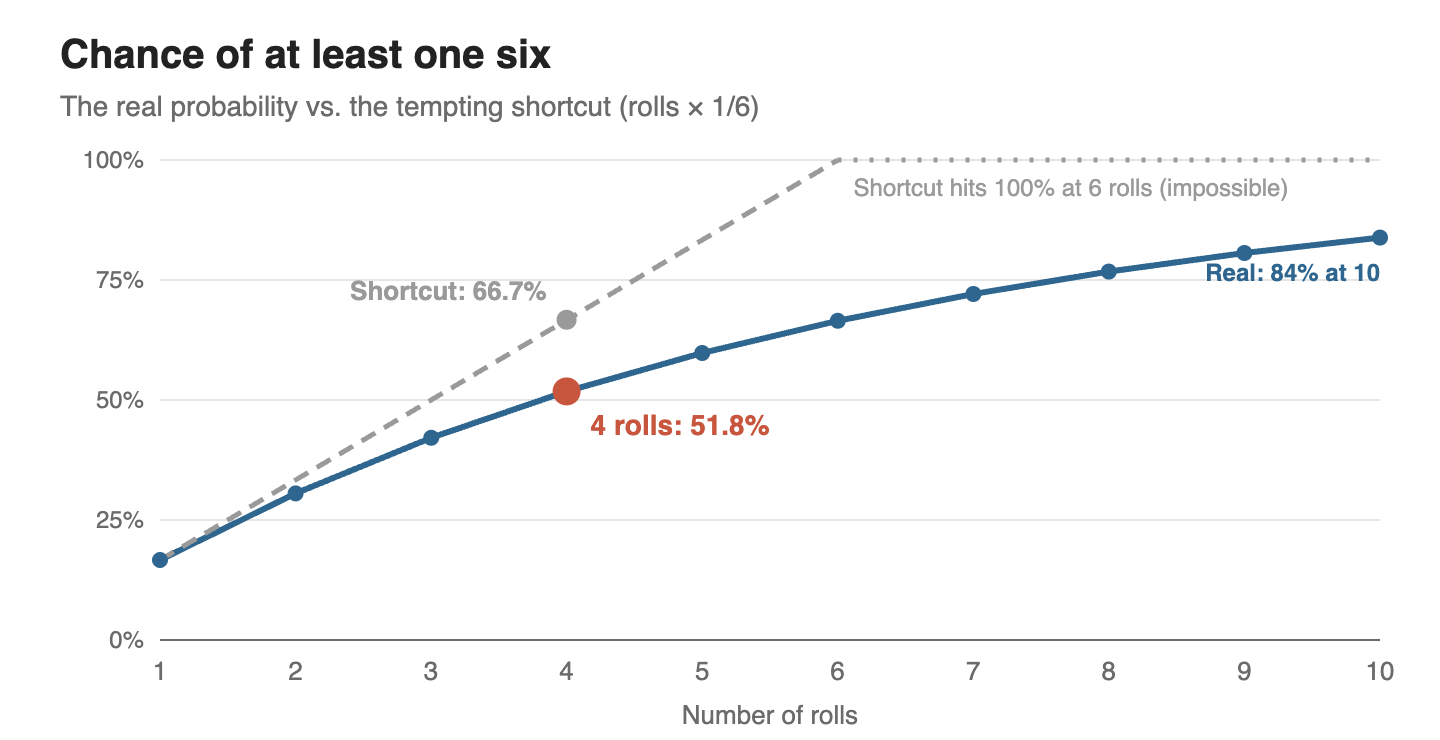
Roll one die four times. What's the chance of getting at least one six?
Tempting but wrong: 4 × 1/6 = 2/3. (By that logic, six rolls would guarantee a six.)
Answer: Find the chance of no sixes, then subtract from 1. Each roll misses with probability 5/6, so four misses is (5/6)⁴ = 625/1296 ≈ 48.2%. The chance of at least one six is about 1 − 0.482 = 51.8%, barely better than even. A French gambler, the Chevalier de Méré, bet on this in the 1600s, and his questions about dice helped prompt Pascal and Fermat to found probability theory.
Go deeper
Dintersmith's Aftermath devotes a chapter to probability, opening with students doing this math in real classrooms and closing with challenges to try yourself.
Next in the series: Pillar 4: Prediction.