The youcubed Portal
Jo Boaler, Stanford's youcubed, and eight tasks that show what math class could be
youcubed is a free math resource center based at Stanford University's Graduate School of Education. It was founded in 2013 by Jo Boaler and Cathy Williams, a former district math director, to put the best research on math learning into the hands of teachers, parents, and students. The site is full of classroom tasks, short videos, posters, and free courses, all built around one idea: math is a subject of patterns, creativity, and reasoning, and everyone can learn it to a high level.
This portal introduces Boaler and her work, points you to the best places to start, and then walks through eight of the tasks that best capture the kind of thinking she argues should be happening in every math classroom in the country.
Who is Jo Boaler?
Jo Boaler began as a math teacher in London comprehensive schools, the British equivalent of American public high schools. Her early research followed students at two English schools for three years: one taught math through traditional textbook drills, the other through open-ended projects. The project-based students did as well or better on national exams and, more strikingly, used their math more flexibly in real life. Her book about that study, Experiencing School Mathematics, won the award for outstanding education book of the year in Britain.
She later held the Marie Curie Professorship of Mathematics Education at the University of Sussex in England, and today she is the Nomellini-Olivier Professor of Education at Stanford. The BBC named her one of eight educators "changing the face of education." She co-leads a national effort to bring data science into K-12 schools, and her books for teachers and parents include:
What's Math Got to Do With It? (2008), for parents and teachers
Mathematical Mindsets (2016), her most influential book for teachers
Limitless Mind (2019), on the brain science of learning
Math-ish (2024), on number sense and estimation
The big ideas
Across her books and the youcubed site, a handful of ideas keep returning:
Everyone can learn math to high levels. There's no such thing as a "math person." Brains grow with effort, and beliefs about ability shape what students achieve.
Mistakes are valuable. Struggle is when learning happens. A classroom where mistakes are welcomed produces braver, deeper thinkers.
Depth over speed. Timed drills and fast recall reward one narrow skill and make many students anxious. Slow, careful thinkers are often the strongest mathematicians.
Number sense over memorized procedures. Students who understand how numbers fit together can always rebuild a fact or a method they've forgotten.
Open tasks with a low floor and a high ceiling. The best problems let every student start and let strong students go a long way.
See it, don't just compute it. Drawing, building, and visualizing activate more of the brain and lead to understanding that lasts.
Math is social. Students learn more when they discuss, justify, and build on each other's ideas.
A fair note
Boaler's influence is enormous; youcubed reports that its ideas reach hundreds of millions of students. Her work is also debated. As a lead writer of California's 2023 Mathematics Framework, she drew sharp criticism from some mathematicians and researchers, who questioned parts of the evidence and the framework's approach to tracking and acceleration. You don't have to settle that argument to see the value of her tasks: they are some of the best invitations to real mathematical thinking anywhere.
Watch and explore
How you can be good at math, and other surprising facts about learning: Boaler's TEDxStanford talk, the best 13-minute introduction to her ideas.
Jo Boaler's TEDx talks: including her Oxford talk on why math is traumatic for so many people.
youcubed video library: classroom footage, number talks, and conversations with mathematicians such as Steven Strogatz, Francis Su, and Keith Devlin.
How to Learn Math: For Students: a free, self-paced course in six short sessions, in English and Spanish.
Week of Inspirational Math(s): free lessons and videos designed to open the school year, or any week.
Data Science at youcubed: lessons and a full high school course.
Rethinking the way we teach math: a September 2026 Stanford podcast conversation with Boaler.
Eight tasks
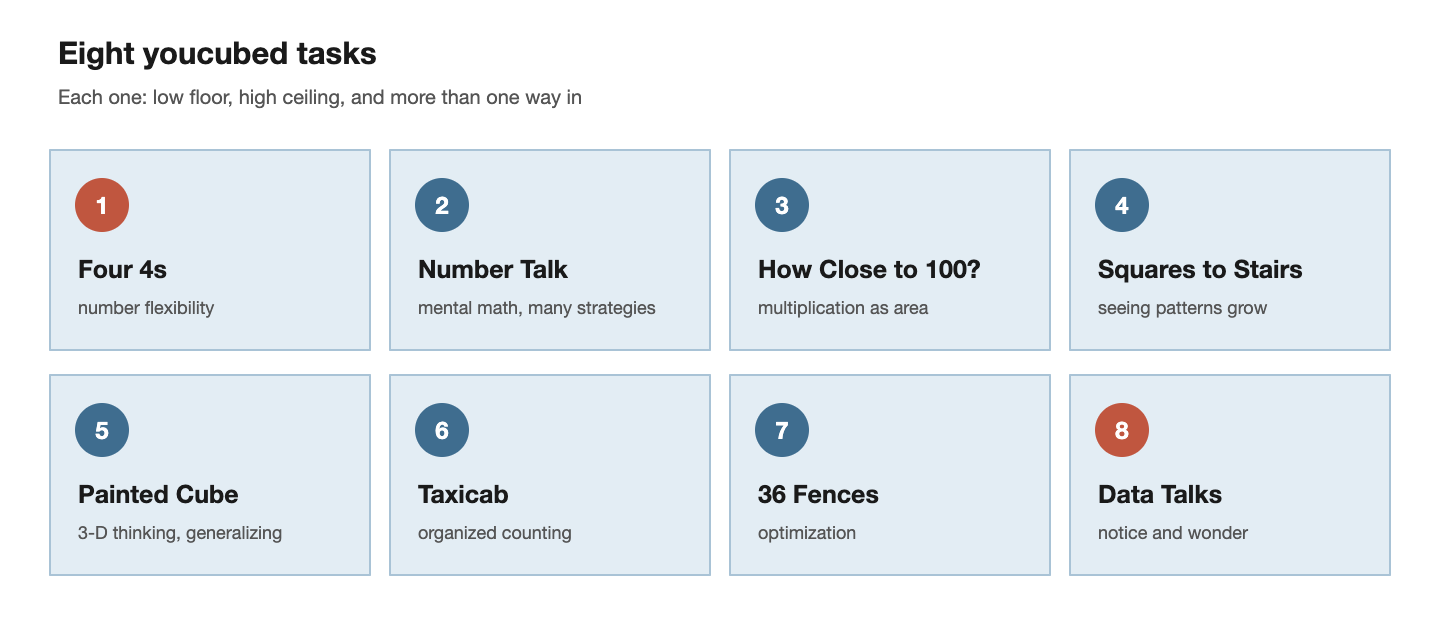
Each post below takes one youcubed task: what it is, the thinking it builds, some ways in, a problem to try with the answer included, and a link to the full task on youcubed. The tasks are youcubed's; the explanations and practice problems are written for Math Thinking Coach. They run roughly from elementary to high school, but every one of them has something for an adult too.
Task 1: Four 4s: every number from 1 to 20, using only four 4s
Task 2: Number Talk, 18 × 5: one calculation, many ways to see it
Task 3: How Close to 100?: a dice game that turns multiplication into area
Task 4: Squares to Stairs: how do you see the pattern growing?
Task 5: The Painted Cube: counting faces, and finding linear, square, and cubic patterns in one problem
Task 6: Taxicab: how many routes across a city grid?
Task 7: 36 Fences: the biggest pen you can build
Task 8: Data Talks: what do you notice? what do you wonder?