The GED Portal
What the GED test is, how it works, and where to start preparing for GED Math
The GED test is a set of four exams that, once passed, earns you a high school equivalency credential. It's a second chance that opens doors: to jobs, job training, college, and the military. Thousands of adults earn it every year, many of them years or decades after leaving school.
This portal explains how the test works, what Rhode Island requires, and then points you to the best free resources on this site and elsewhere for the part most people worry about most: math.
The four tests
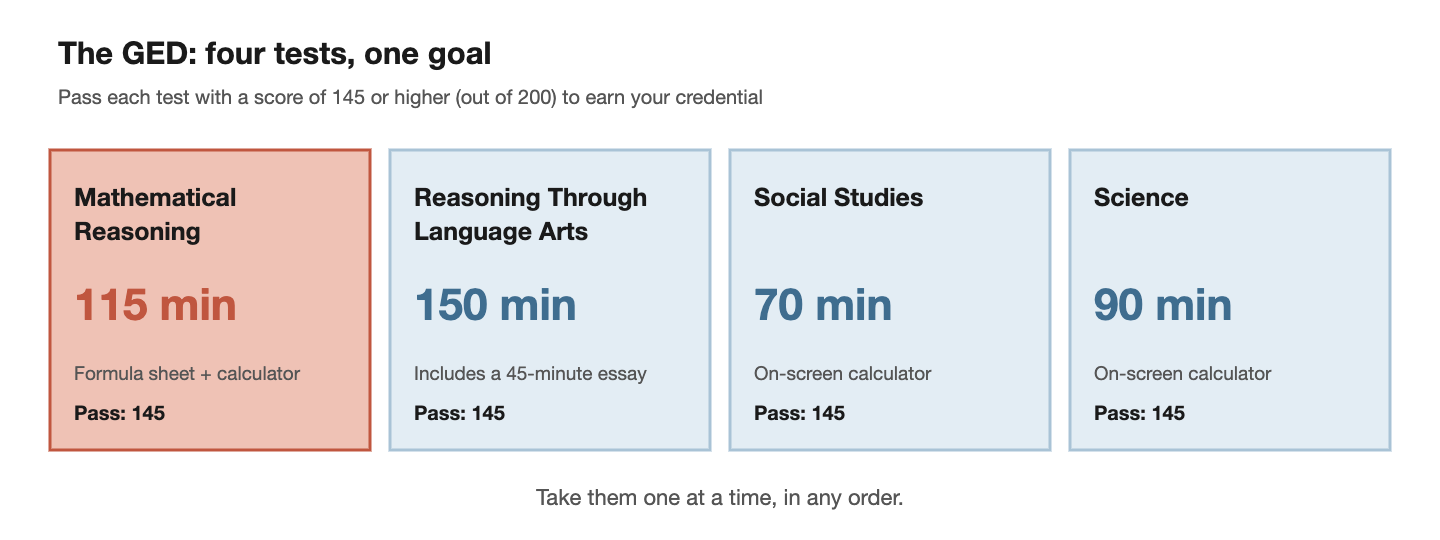
The GED is made up of four separate tests. You can take them one at a time, in any order, and you only pay for the ones you're ready for.
Mathematical Reasoning: 115 minutes, in two parts. You get a formula sheet and an on-screen calculator.
Reasoning Through Language Arts: 150 minutes, including a 45-minute essay.
Social Studies: 70 minutes, with an on-screen calculator.
Science: 90 minutes, with an on-screen calculator.
Each test is scored from 100 to 200. You need 145 on each test to pass, and passing all four earns the credential.
In Rhode Island
You must be at least 18 and a Rhode Island resident. Students who are 16 or 17 can test if they submit an approved alternative learning plan from their school.
You don't have to take a class first, although free adult education classes can help a lot.
If you test at a testing center, you don't need to take the official practice test first. If you test online at home, you must first take the GED Ready practice test and do well enough on it.
Rules can change, so check the Rhode Island page on GED.com for the latest.
Start at GED.com
Everything official begins with a free account at GED.com. From there you can take free sample tests, find classes, schedule your tests, and see your scores.
GED Ready is the official practice test, written by the same people who write the real one. It costs a few dollars per subject and tells you whether you're likely to pass. It's the best single check before you schedule the real test.
GED Math: what's on it
The math test covers four areas:
Basic math: fractions, decimals, percents, ratios, and rates
Geometry: perimeter, area, volume, and the Pythagorean theorem
Basic algebra: expressions, equations, and inequalities
Graphs and functions: reading graphs, slope, and linear and quadratic functions
The first few questions must be answered without a calculator. For the rest you get the TI-30XS on screen, so it's worth practicing on that calculator. A formula sheet is provided, so you don't need to memorize area and volume formulas. You do need to know which one to use.
Where to practice
GED Math resources: this site's GED Math page, with study tips, the formula sheet, and a downloadable guide
GED Math: Khan Academy Practice Guide: every skill on the test linked to free Khan Academy practice, in six sections
The IXL Portal: IXL has a skill plan built around the GED math test, with practice for every skill. The Aquidneck Island Adult Learning Center in Newport now uses IXL with its GED students
Get Sum Math: short video lessons, practice problems, and three full practice tests
A good way to prepare
Find your starting point. Take a free sample test on GED.com or a course challenge on Khan Academy.
Work one skill at a time. Pick the weakest topic, watch a short lesson, then practice until it feels solid.
Practice a little, often. Thirty minutes most days beats a long session once a week.
Check yourself with GED Ready. When you score "likely to pass," schedule the real test.
Try it yourself
A 12-pack of seltzer costs $5.40. A 20-pack costs $8.60. Which is the better buy?
Answer: Find the price per can. $5.40 ÷ 12 = $0.45 a can. $8.60 ÷ 20 = $0.43 a can. The 20-pack is the better buy, by 2 cents a can. Questions like this, about unit rates and comparing prices, show up often on the GED math test.
Back to Test Readiness