youcubed Task 5: The Painted Cube
Counting faces, and finding linear, square, and cubic patterns in one problem
November 23, 2026
Task 5 of 8 in the youcubed Portal, a series on tasks from Jo Boaler's youcubed center at Stanford. The task is youcubed's; the explanations and practice problems are written for Math Thinking Coach.
Build a large cube out of 64 small cubes, 4 along each edge. Dip the whole thing in blue paint so every outside face is covered. Now take it apart.
How many of the small cubes have paint on 3 faces? On 2 faces? On 1 face? On none?
Try to picture it before reading on. Sugar cubes or building blocks help a lot.
Counting the 4 × 4 × 4 cube
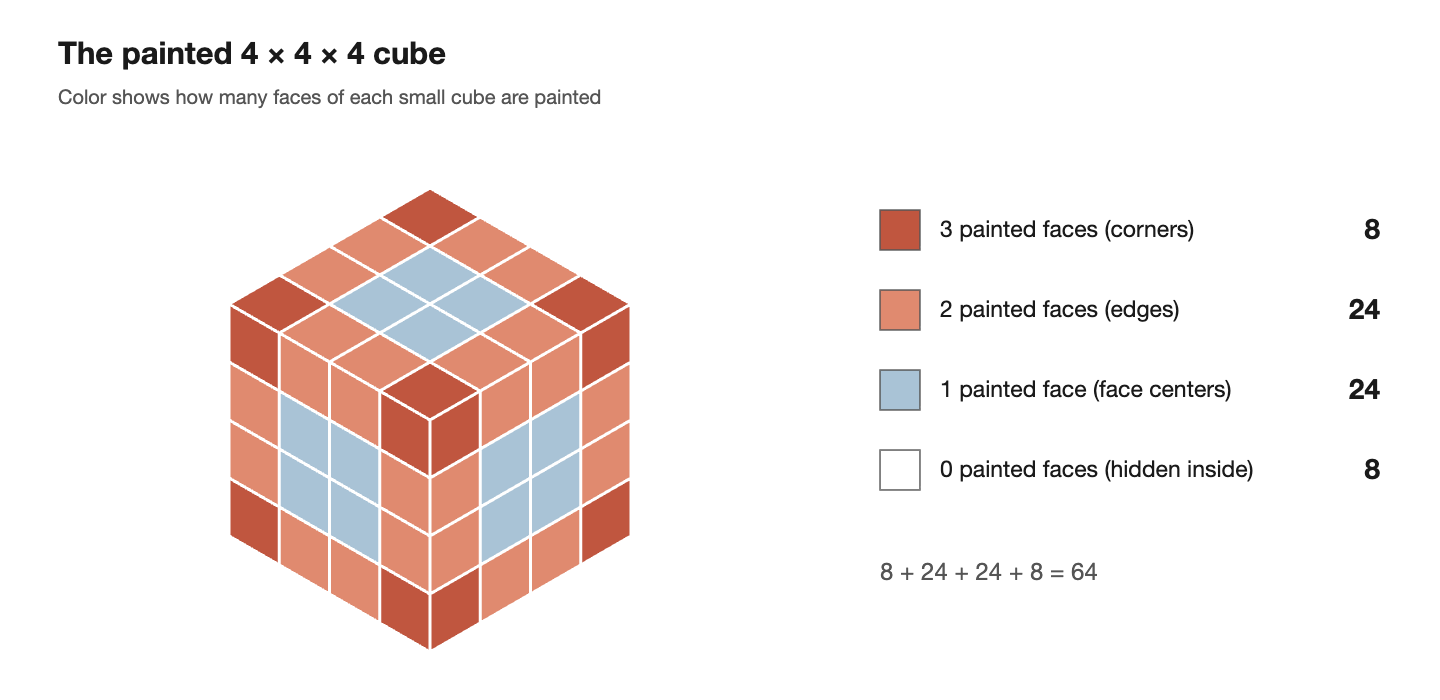
3 painted faces: only the corners. A cube has 8 corners, so 8.
2 painted faces: the cubes along the edges, not counting corners. Each of the 12 edges has 4 cubes, and 2 of those are corners, which leaves 2 per edge. 12 × 2 = 24.
1 painted face: the cubes in the middle of each face. Each face is a 4-by-4 square; take away the border and a 2-by-2 square is left. 6 faces × 4 = 24.
0 painted faces: the hidden inside, a 2-by-2-by-2 cube. 8.
Check: 8 + 24 + 24 + 8 = 64. Every cube is accounted for.
Any size cube
Now the real question: what if the cube were 5 on a side? 10? Any size n?
Each category follows the same reasoning. Strip away the outer layer and every count depends on n − 2:
3 faces: always 8, no matter how big the cube
2 faces: 12 × (n − 2), which grows in a straight line
1 face: 6 × (n − 2)², which grows like a square
0 faces: (n − 2)³, which grows like a cube
That's the beauty of the problem: a constant, a linear pattern, a quadratic pattern, and a cubic pattern, all inside one cube, and each one has a reason you can see. The four always add up to n³.
Why Boaler loves it
This is one of the tasks Boaler uses with her own Stanford undergraduates; youcubed has a short film of her class working on it. It shows several of her core ideas at once:
Visual thinking. Students who can see the cube in their mind, or build it, have a huge advantage over students trying to guess a formula.
Conjecture and proof. Students collect data from small cubes, guess a pattern, and then explain why it must work for every size.
Low floor, high ceiling. A fifth grader can count the 3 × 3 × 3 cube. A high school student can derive all four formulas and prove they sum to n³.
Try it yourself
For a 10 × 10 × 10 cube, how many small cubes have 3, 2, 1, and 0 painted faces?
As cubes get bigger, the unpainted inside eventually outnumbers the cubes with one painted face. At what size does that first happen?
Answer:
3 faces: 8. 2 faces: 12 × 8 = 96. 1 face: 6 × 8² = 384. 0 faces: 8³ = 512. Check: 8 + 96 + 384 + 512 = 1,000.
Compare (n − 2)³ with 6 × (n − 2)². The inside wins when n − 2 is more than 6. At n = 8 they tie exactly, 216 each. At n = 9, the inside pulls ahead, 343 to 294.
Go deeper
The task and suggested materials are at youcubed: Painted Cube. Look for the film of Boaler's Stanford class working on it in the youcubed video library.
Next in the series: Task 6: Taxicab