youcubed Task 4: Squares to Stairs
How do you see the pattern growing?
November 23, 2026
Task 4 of 8 in the youcubed Portal, a series on tasks from Jo Boaler's youcubed center at Stanford. The task is youcubed's; the explanations and practice problems are written for Math Thinking Coach.
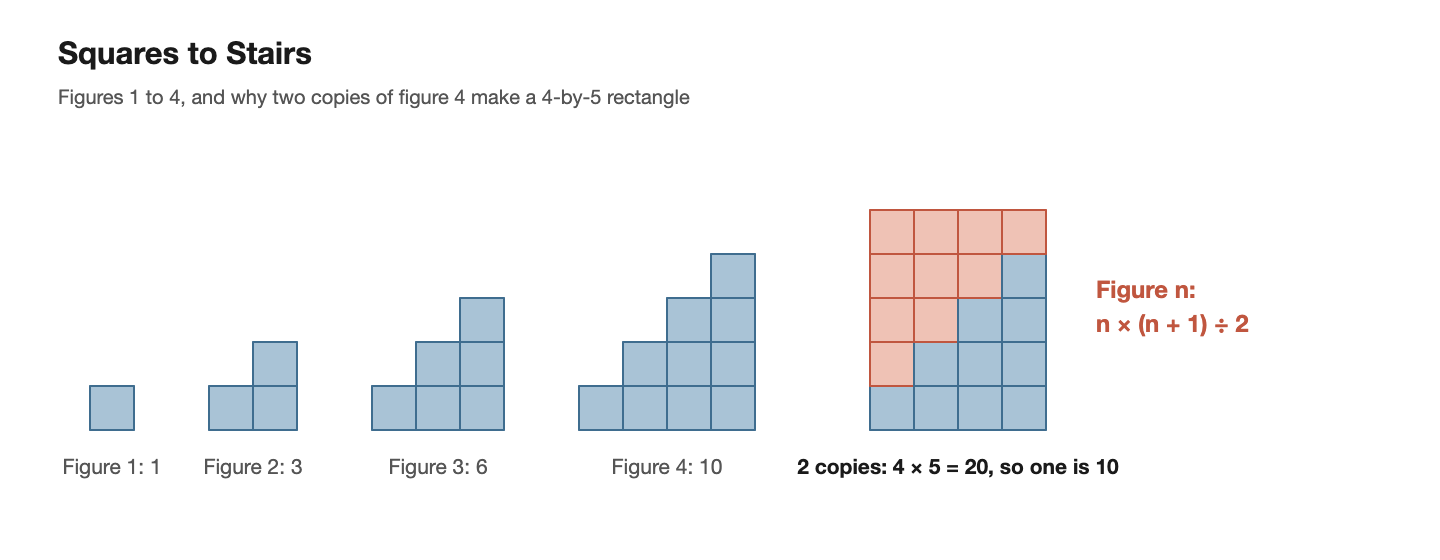
Picture a staircase built from squares. Figure 1 is a single square. Figure 2 has a column of 1 square next to a column of 2. Figure 3 has columns of 1, 2, and 3. Each new figure adds one taller column on the right.
So the figures have 1, 3, 6, … squares.
Before you count anything else, Boaler asks a different first question: how do you see the pattern growing?
Ways of seeing
Ask a room of people and you'll get different answers. Each one is correct, and each one leads somewhere different.
Column by column. Each figure adds a new column one taller than the last. Figure 10 is 1 + 2 + 3 + … + 10.
Row by row. Each figure adds a new step along the bottom. Same total, built sideways.
Pairing. Pair the shortest column with the tallest, the second shortest with the second tallest, and so on. In figure 10, each pair (1 + 10, 2 + 9, 3 + 8, …) makes 11, and there are 5 pairs. That's 55. This is the trick the young Carl Friedrich Gauss is said to have used to add the numbers from 1 to 100.
Two staircases make a rectangle. Make a copy of figure 10, flip it upside down, and fit it against the original. Together they form a rectangle 10 wide and 11 tall: 110 squares. One staircase is half that, 55.
The last picture gives a rule for any figure. Figure n has n × (n + 1) ÷ 2 squares.
The youcubed questions
The task then asks:
How many squares are in figure 10? (55)
How many in figure 55? (55 × 56 ÷ 2 = 1,540)
Can you make a staircase using exactly 190 squares? (Yes: 19 × 20 ÷ 2 = 190, so it's figure 19.)
Can you make one using exactly 1,478 squares?
Why Boaler loves it
Most textbook pattern problems jump straight to "how many squares in the 100th figure?" Boaler argues that skipping the seeing step is a mistake. When students first describe how a shape grows, they each bring a different way of seeing, and each way turns into a different-looking algebraic expression. Comparing them is how students come to understand why the expressions are equal, and what a variable actually means.
It's also a problem where the visual thinkers often outshine the fast calculators, which is exactly the point. In her TEDxStanford talk, Boaler uses a growing-shape problem like this to show how many ways there are to see one pattern.
Try it yourself
Can you build a staircase using exactly 1,478 squares? If not, how many more squares would you need to make the next complete staircase?
Answer: No. Figure 53 has 53 × 54 ÷ 2 = 1,431 squares, and figure 54 has 54 × 55 ÷ 2 = 1,485. Since 1,478 falls between them, it can't be a complete staircase. You'd need 1,485 − 1,478 = 7 more squares to finish figure 54.
A quick way to find the right figure: n × (n + 1) ÷ 2 is close to n² ÷ 2, so for 1,478 squares, n² is about 2,956, and n is about 54.
Go deeper
The task, with classroom notes and student work, is at youcubed: Squares to Stairs.
Next in the series: Task 5: The Painted Cube