youcubed Task 1: Four 4s
Every number from 1 to 20, using only four 4s
November 23, 2026
Task 1 of 8 in the youcubed Portal, a series on tasks from Jo Boaler's youcubed center at Stanford. The task is youcubed's; the explanations and practice problems are written for Math Thinking Coach.
Here's the challenge. Can you make every whole number from 1 to 20 using exactly four 4s?
You can use any operation you know: add, subtract, multiply, divide, parentheses, square roots, exponents, and decimals. You can also push two 4s together to make 44. The only rule is that every expression must use exactly four 4s, no more and no fewer.
Getting started
The first few come quickly:
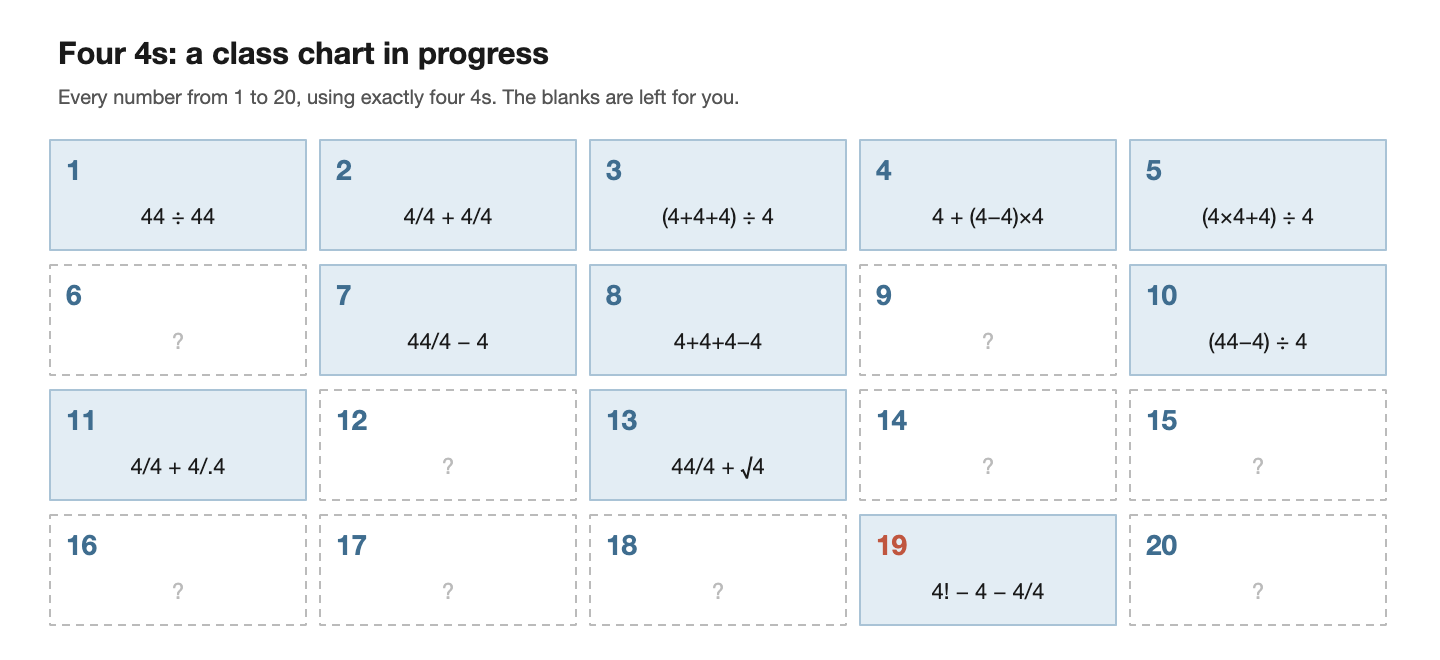
1 = 44 ÷ 44
2 = 4/4 + 4/4
3 = (4 + 4 + 4) ÷ 4
4 = 4 + (4 − 4) × 4
5 = (4 × 4 + 4) ÷ 4
Then it gets more interesting. A few more, to show the kinds of moves that help:
7 = 44/4 − 4 (44 ÷ 4 is 11)
10 = (44 − 4) ÷ 4
11 = 4/4 + 4/.4 (4 ÷ 0.4 is 10)
13 = 44/4 + √4
Some numbers resist. When a class gets stuck, someone usually asks whether there's an operation that makes numbers grow fast. That's the moment to introduce the factorial: 4! means 4 × 3 × 2 × 1 = 24. Suddenly 19 = 4! − 4 − 4/4 falls into place.
Why Boaler loves it
Boaler often uses Four 4s on the first day of school. It isn't new; the puzzle appeared in W. W. Rouse Ball's Mathematical Recreations and Essays in 1892. But it does several things a first-day worksheet can't:
Everyone can start. A student who only knows addition can find 8 = 4 + 4 + 4 − 4.
There's no single answer. Most numbers can be made many ways, so students compare and admire each other's solutions instead of checking against a key.
It invites students to the board. In Boaler's version, students post solutions on a class chart as they find them. Reluctant students can contribute one small result and feel part of the effort.
It creates a need for new math. Factorials, square roots, and decimals arrive because students want them, not because the textbook says so.
The thinking this builds is number flexibility: seeing that 10 is 4 ÷ 0.4, that 11 is 44 ÷ 4, that 2 is √4. Boaler argues this kind of flexibility is what separates strong math students from those who rely on memorized steps.
Try it yourself
Make 17 and 20 using exactly four 4s each.
Answer: 17 = 4 × 4 + 4/4. For 20, one way is (4 + 4/4) × 4, which is 5 × 4. Another is 4 × 4 + √4 + √4. If you found a different expression, check that it uses exactly four 4s; if it does, it's just as good.
Keep going
Can you make all the numbers from 21 to 30?
Can you make negative numbers?
How many numbers can you make with five 5s?
Invent your own version, like three 2s and two 3s, and try it on a friend.
Go deeper
See the full task, teacher notes, and grade-level versions at youcubed: Four 4s (grades 5 to college).
Next in the series: Task 2: Number Talk, 18 × 5