youcubed Task 2: Number Talk, 18 × 5
One calculation, many ways to see it
November 23, 2026
Task 2 of 8 in the youcubed Portal, a series on tasks from Jo Boaler's youcubed center at Stanford. The task is youcubed's; the explanations and practice problems are written for Math Thinking Coach.
Without paper or a calculator, work out 18 × 5 in your head.
Got it? Now the more interesting question: how did you do it?
Six ways to 90
When Boaler asks this question of students, teachers, or parents, a room almost always produces several different methods. Here are some of the most common:
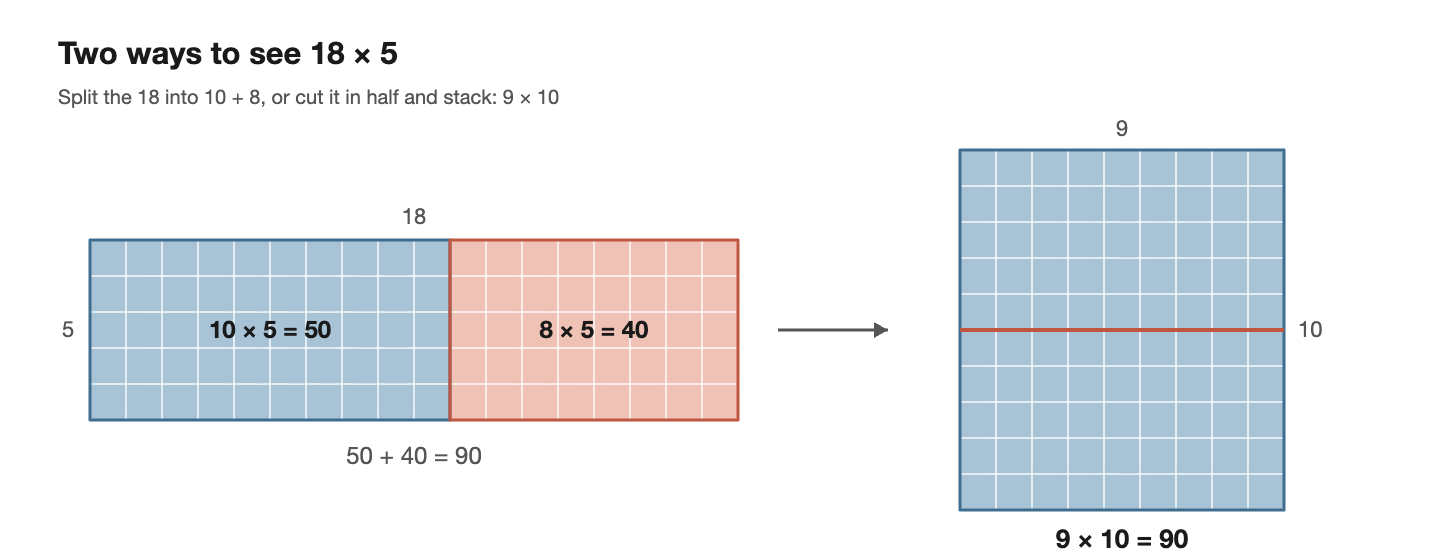
Split the 18: 10 × 5 = 50 and 8 × 5 = 40, so 50 + 40 = 90.
Round up, then fix it: 20 × 5 = 100, but that's two 5s too many, so 100 − 10 = 90.
Halve and double: half of 18 is 9, double 5 is 10, and 9 × 10 = 90.
Times ten, then halve: 18 × 10 = 180, and since 5 is half of 10, the answer is half of 180, or 90.
Two nines: 9 × 5 = 45, and two of those make 90.
Count by fives: 5, 10, 15, … eighteen times. Slower, but it works, and it's honest.
Every one of these can be drawn. Picture a rectangle 18 units long and 5 units tall. Cut it into a 10-by-5 piece and an 8-by-5 piece and you have the first method. Cut it down the middle into two 9-by-5 pieces and you have the fifth. Slide one of those halves on top of the other and you get a 9-by-10 rectangle: halving and doubling.
What a number talk is
A number talk is a short classroom routine, usually 10 to 15 minutes, developed by educators Ruth Parker and Kathy Richardson and popularized by Boaler and youcubed. The teacher writes one calculation on the board. Students think silently and signal quietly, often with a thumb against their chest, when they have an answer. Then the teacher collects answers, right and wrong, without judgment, and asks students to explain their methods. The teacher records each method in numbers and in a picture.
The answer turns out to be the least interesting part.
Why Boaler loves it
Boaler argues that the students who struggle most in math are often the ones who were taught to treat it as a set of procedures to memorize. Students who do well tend to use number sense: they see 18 as 20 − 2 or as 2 × 9 and choose whatever makes the problem easy. Number talks build exactly that flexibility, and they do it without timed drills, which Boaler believes create anxiety and reward speed over thinking.
They also change who feels smart. The student who counted by fives has a valid method, and the student who halved and doubled can explain why it works. Everyone learns from everyone.
Try it yourself
Work out 25 × 16 in your head, two different ways.
Answer: 400. Some ways in:
25 × 4 = 100, and 16 is 4 × 4, so 100 × 4 = 400.
Halve and double: 50 × 8 = 400.
Split: 25 × 10 = 250 and 25 × 6 = 150, so 250 + 150 = 400.
If you found a third way, draw it as a rectangle and see how it fits.
Go deeper
Watch Boaler explain number talks in a short excerpt from her online course: Number Talks, from How to Learn Math. For a version you can do with your own kids on a walk, see Number Talks (all ages).
Next in the series: Task 3: How Close to 100?