youcubed Task 3: How Close to 100?
A dice game that turns multiplication into area
November 23, 2026
Task 3 of 8 in the youcubed Portal, a series on tasks from Jo Boaler's youcubed center at Stanford. The task is youcubed's; the explanations and practice problems are written for Math Thinking Coach.
youcubed calls this one of its most popular tasks, and it's easy to see why. All you need is a 10-by-10 grid, two dice, and a partner.
How to play
Two players share one blank 10-by-10 grid of 100 squares.
On your turn, roll both dice. The two numbers are the length and width of a rectangle. Roll a 3 and a 5, and you draw a 3-by-5 rectangle anywhere on the grid and write 3 × 5 = 15 inside it.
Rectangles can't overlap. You can turn a rectangle either way, so a 3-by-5 can also go in as a 5-by-3.
If your rectangle won't fit anywhere, you skip that turn.
The game ends when neither player can place another rectangle. The goal: fill the grid as close to 100 squares as you can.
A variation: each player gets their own grid, and whoever gets closest to 100 wins.
The math inside the game
On the surface it's multiplication practice. Underneath, a lot more is going on:
Multiplication is area. Students see that 3 × 5 is literally the number of squares in a 3-by-5 rectangle. That picture will carry them all the way to multiplying polynomials in algebra.
Order doesn't matter. Turning a 3-by-5 into a 5-by-3 shows that 3 × 5 = 5 × 3 without anyone having to say "commutative property."
Strategy. Where you place a big rectangle early decides how much room is left later. Players start thinking about leftover shapes and which rolls they can still use.
Chance. Players quickly notice that some rectangles are hard to get. A 6-by-6 needs double sixes.
Why Boaler loves it
Boaler is a sharp critic of timed multiplication tests. She argues that math facts are best learned the way you learn a friend's phone number: through repeated, meaningful use, not stopwatch drills. How Close to 100? has students multiplying dozens of times in a session, but no one is racing a clock, and every product comes with a picture. Teachers have adapted it endlessly, with 400-square grids, extra dice, or fractions.
Try it yourself
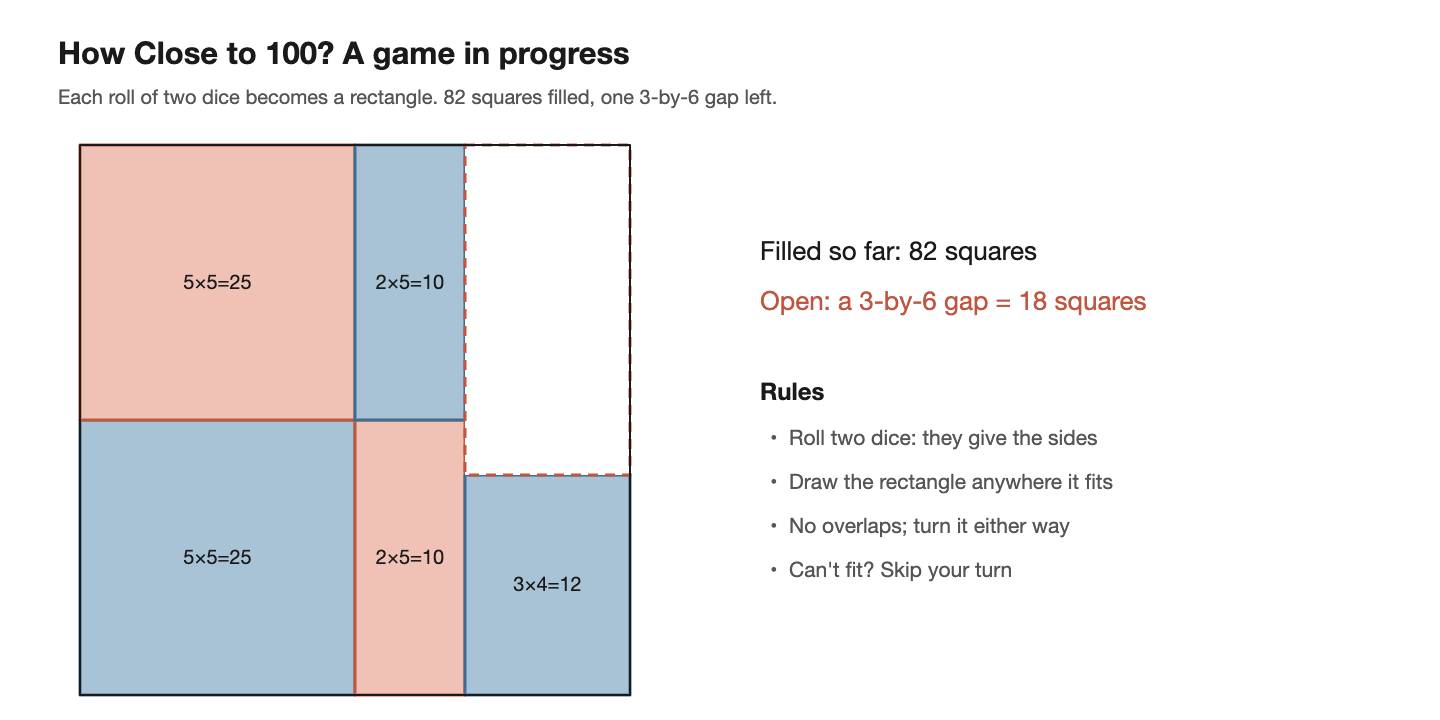
You and your partner have filled 82 squares. The only open space left is a strip 3 squares wide and 6 squares long.
What roll would bring you to exactly 100?
What's the chance you roll it?
What's the chance your roll fits in the strip at all?
Answer:
A 3 and a 6, which fills the strip: 82 + 18 = 100.
Two dice have 36 equally likely outcomes, and two of them work: (3, 6) and (6, 3). So the chance is 2/36, about 6%.
Any rectangle fits as long as one side is 3 or less, since the longer side can never be more than 6. The only rolls that don't fit are those where both dice show 4, 5, or 6: that's 3 × 3 = 9 of the 36 outcomes. So 27/36, or 3/4, of all rolls fit.
Go deeper
The full game, with a recording sheet, is at youcubed: How Close to 100?
Next in the series: Task 4: Squares to Stairs